
 Retaining WallsView full size
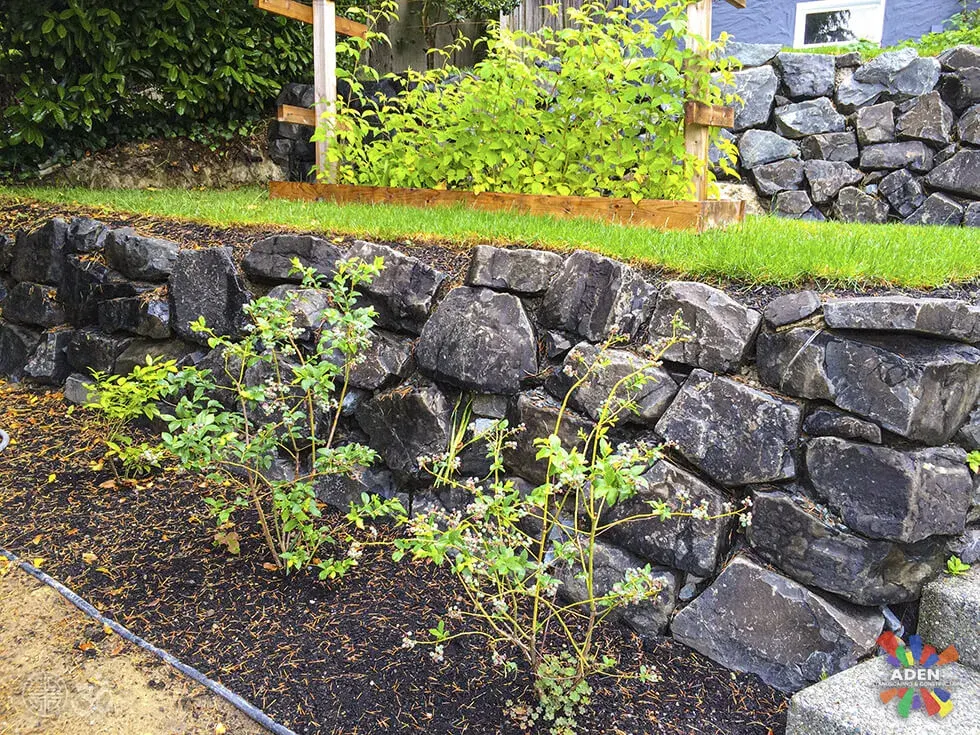
Basalt rockery above a new bed
Quarried basalt set as a rockery rather than laid as block. It suits a rural lot better, and it lets the planting run into the joints instead of stopping dead at a straight line.
No down payment. You pay when the project is finished.
Monday – Friday, 9:00 AM – 7:00 PM · Capitol Hill, Seattle
Landscape Design · Woodinville
The most useful thing a design does on a Woodinville acreage property is draw a line. The common failure here is a scheme spread evenly across the whole property, which produces a maintenance commitment nobody sustains and, within three seasons, an acre of half-kept ground. What works is a defined, properly built garden near the house — surfaces, planting, lighting, the parts you use daily — with the wider property managed as meadow, woodland or paddock at a fraction of the input. It reads better than a diluted garden and costs a fraction to keep. The practical constraints are septic and wells, both of which fix where things can go.
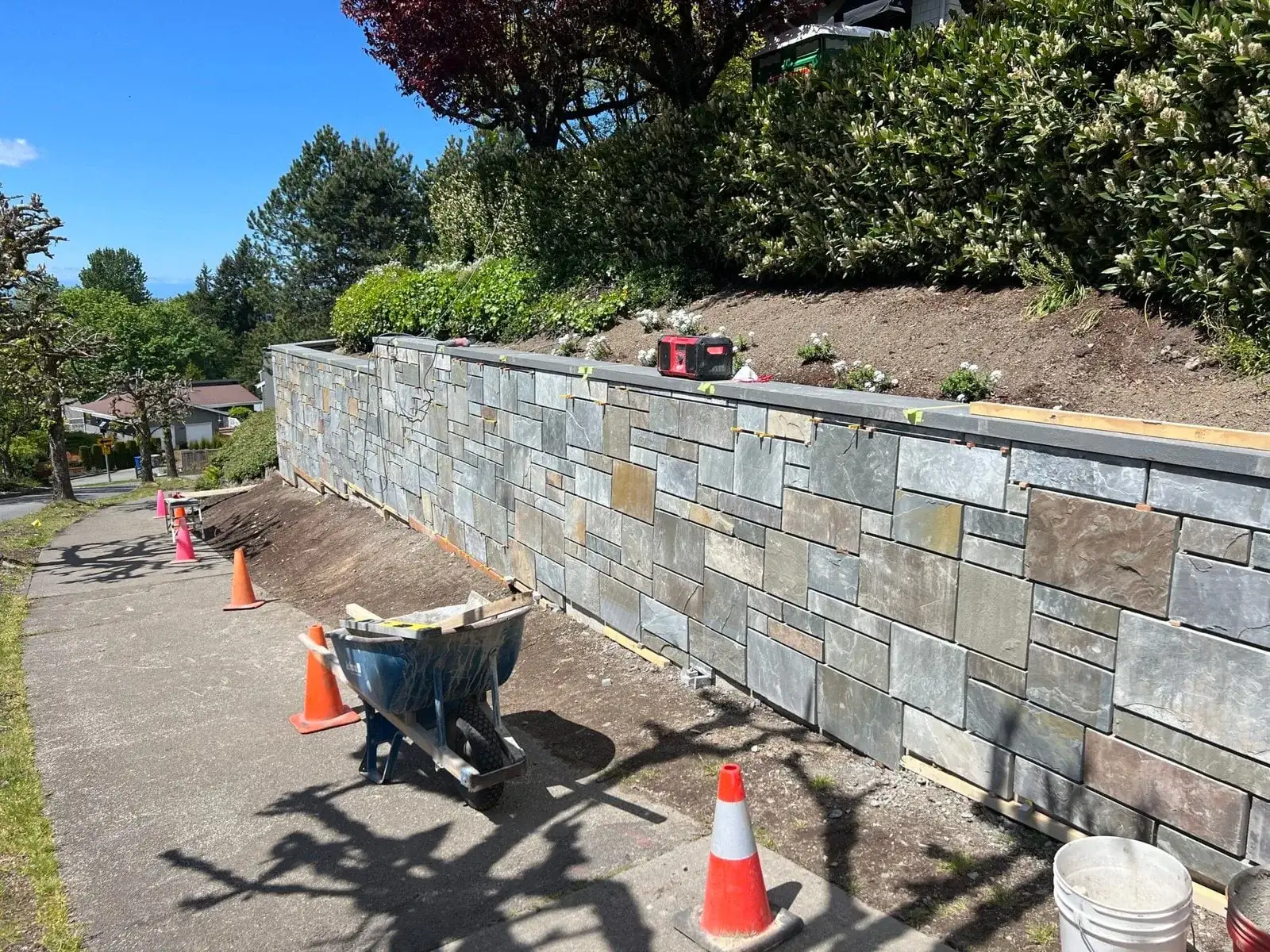
Natural stone veneer retaining wall under construction with tools and materials on a Woodinville site
What we get called about
Woodinville has the largest properties we work on, and acreage changes the nature of the job. The design problem stops being how to fit things into a small space and becomes how to give a large one structure — which usually means deciding what part of it is garden and letting the rest be landscape rather than trying to maintain all of it. Practically, several properties here are on wells and septic, which constrains irrigation design and dictates where you cannot excavate. And the valley floor is a different world from the hills: high water table, flat ground, slow drainage.
Worth knowing in Woodinville
Decide where the garden stops before you decide what is in it. On an acreage property that single line does more for the finished result — and for what it costs to keep — than any other decision in the design.
On a property of an acre or more, the instinct is to spread the budget across the whole thing so that everything looks tended. It is the most reliable way to end up with a garden that is thin everywhere and good nowhere, and a maintenance burden that outlives the enthusiasm for it.
The alternative is a deliberate hierarchy. A defined garden area close to the house gets the full specification — proper surfaces, planting with real depth, lighting, irrigation where it is needed. It is the part you use every day and see from every window, and it justifies the investment.
Beyond it, the property is managed rather than gardened: meadow that gets cut once or twice a year, woodland that needs occasional attention rather than weekly work, mown paths that make the wider land walkable without making it a lawn. The input drops by an order of magnitude and the property looks intentional rather than neglected, because there is a clear reason for the change rather than a gradient of decreasing effort.
The line between the two is the most important thing in an acreage design. It wants to be legible — a hedge, a change of level, a fence line, a path — so that the wider land reads as deliberate rather than as the bit that ran out of budget.
The method
The sequence does not change between neighbourhoods — what changes is the ground it is applied to. Full detail on the landscape design service page.
What you want to use it for, who else uses it, what you hate about it now. Most of the useful information comes out of the second half of that conversation.
Grade, drainage, soil, existing trees and where a machine can get in. This is the half of design that never appears in a photograph and decides most of what is possible.
Where the paved area goes, how big it really needs to be, what the route through the garden is. Getting these wrong cannot be fixed with better planting.
Real products, real quantities, and a fixed written price with the assumptions stated so you can see what is included.
Clearing, drainage, structural, surfaces, irrigation and lighting sleeves, then planting and finishes. The order is the difference between a build and a rework.
What it costs in Woodinville
Woodinville design and installation runs $8,000 to $70,000, and on acreage the number is decided almost entirely by how much of the property is treated as garden. A well-defined half-acre-adjacent garden with the rest managed simply can sit mid-range; attempting to landscape a full acre goes past the top of it quickly and rarely produces a better result.
You pay after the project is fully completed.
The estimate you sign is the price you pay.
Spread the cost with no interest.
Covers hardscape work; vegetation excluded.
Local questions
General questions about this service are on the service page. These are the ones that only come up here.
Less than most people start out planning, and the constraint is maintenance rather than money. A defined garden area close to the house — the part you use daily and see from every window — justifies a full specification. Beyond it, meadow, woodland or paddock managed a few times a year looks intentional and costs a fraction to keep. The critical detail is that the boundary between them should be legible: a hedge, a level change, a path. Without a clear line, the wider land reads as the bit that ran out of budget rather than as a deliberate choice.
They fix points on the plan that cannot move. A septic drainfield needs the ground above and around it undisturbed, uncompacted and not covered — so no hard surfaces, no deep-rooted planting, no machinery across it, and on a large lot it is frequently sited in the flattest, sunniest, most appealing spot. A private well constrains irrigation to what the well can actually deliver in flow and recovery rather than municipal pressure, which changes zone sizes and run times. Both need locating before the design rather than during the build.
Substantially, and it is worth knowing which one you have. Up on the hill you are on glacial till with grade, where water perches on hardpan and drainage is a routine question. Down on the Sammamish Valley floor the soil is alluvial and the water table sits close to the surface, so the ground stays wet for months and anything needing sharp drainage will struggle regardless of planting technique. A property at the bottom of the hill and one at the top can need genuinely opposite palettes, which makes it the first thing we establish.
Yes, and on acreage it is usually the sensible route — a whole-property scheme built in one season is a large commitment and rarely necessary. The rule is the same as anywhere: everything buried goes in during the first phase, because retrofitting drainage, irrigation runs and lighting conduit across a large property is disproportionately expensive. After that, the defined garden area is usually built first and completely, because a finished small garden is worth far more than three unfinished large ones.
Serving Woodinville and surrounding neighbourhoods
Downtown Woodinville · Hollywood Hill · Wellington · Cottage Lake · Sammamish Valley wine district · Bear Creek edge
98072 · 98077
Recent work
Retaining WallsView full sizeQuarried basalt set as a rockery rather than laid as block. It suits a rural lot better, and it lets the planting run into the joints instead of stopping dead at a straight line.
 StoneworkView full size
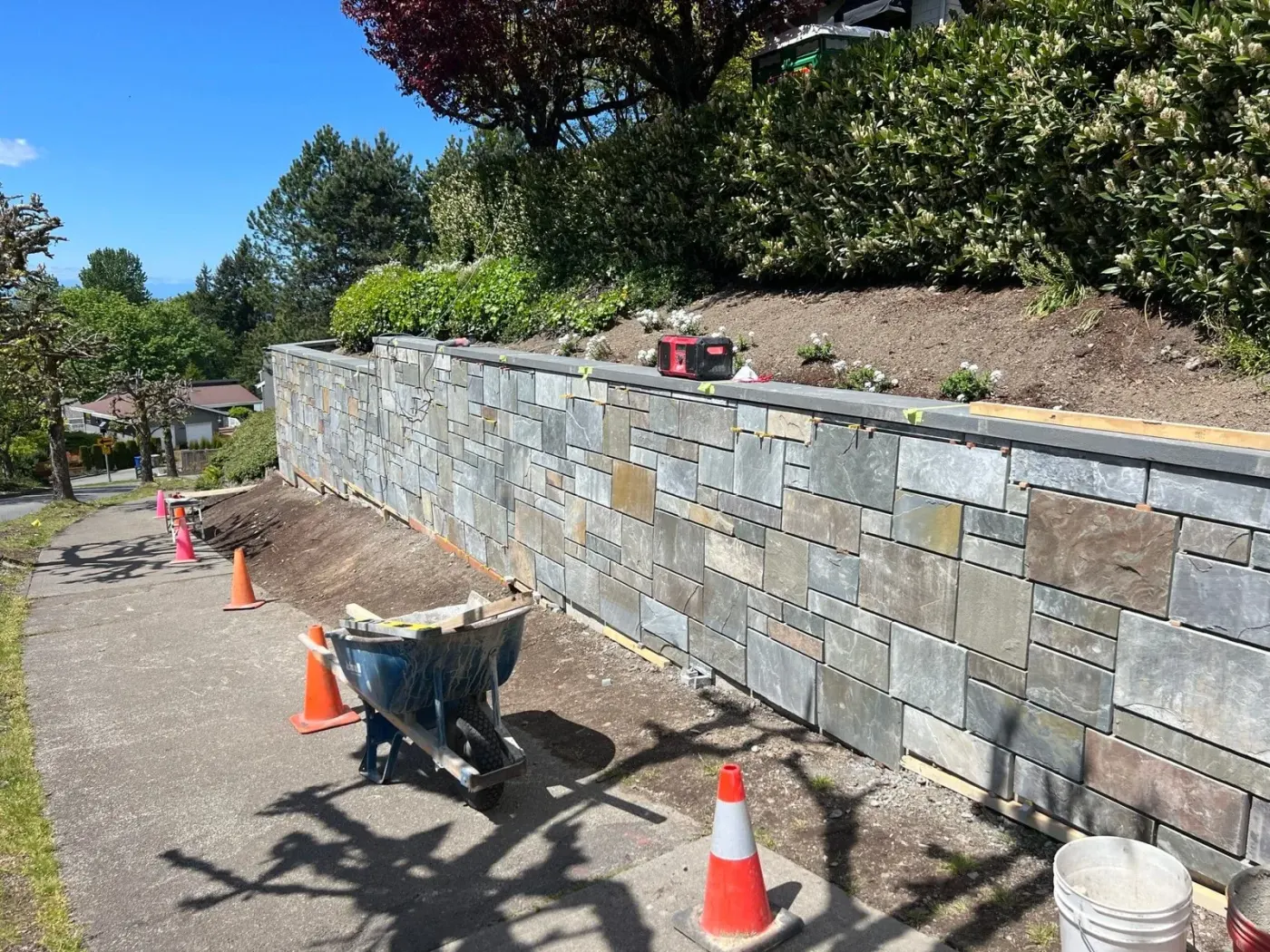
Stone veneer going up over a structural core — the part of the job nobody photographs, done properly.
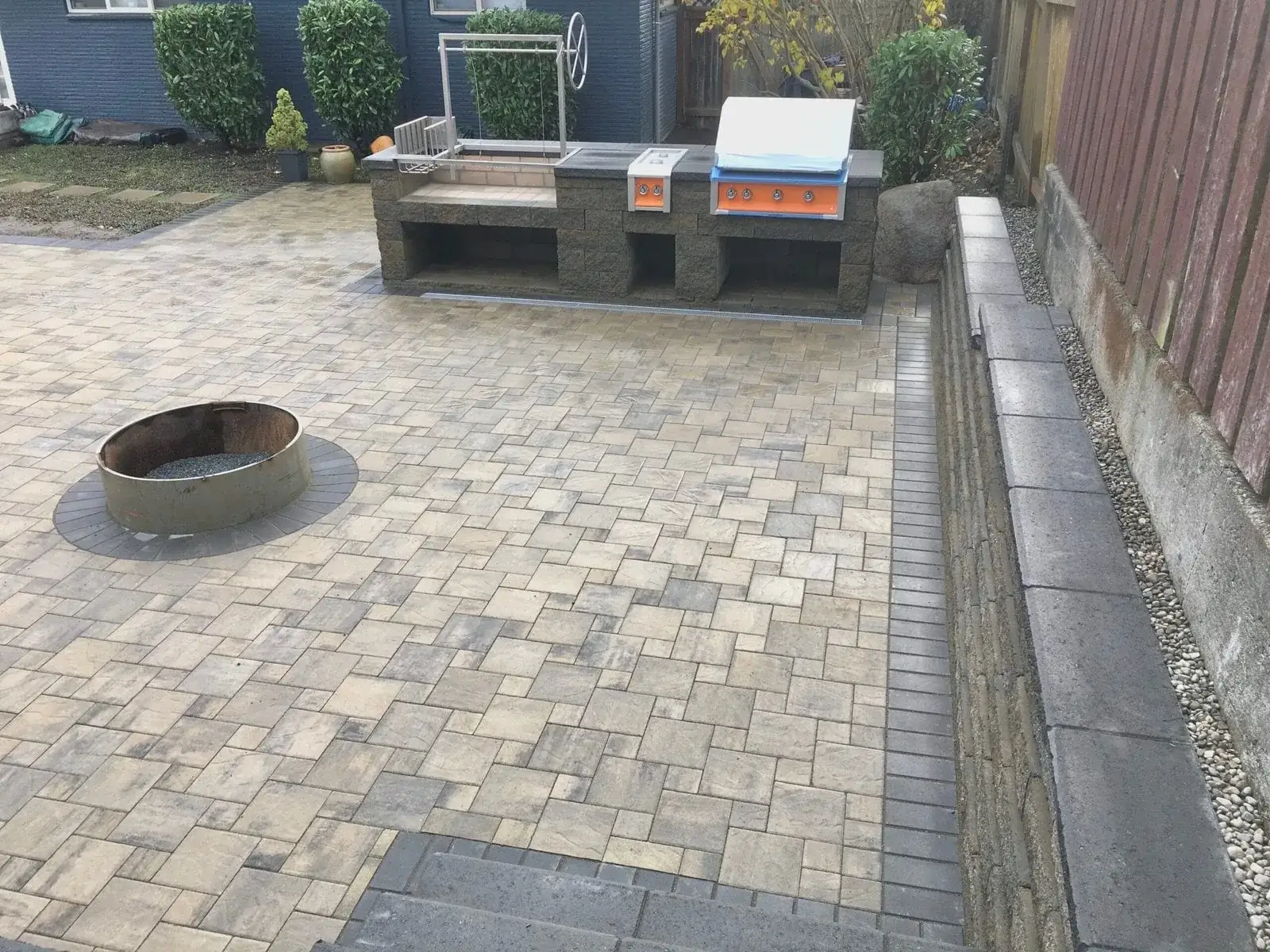
 Outdoor LivingView full size
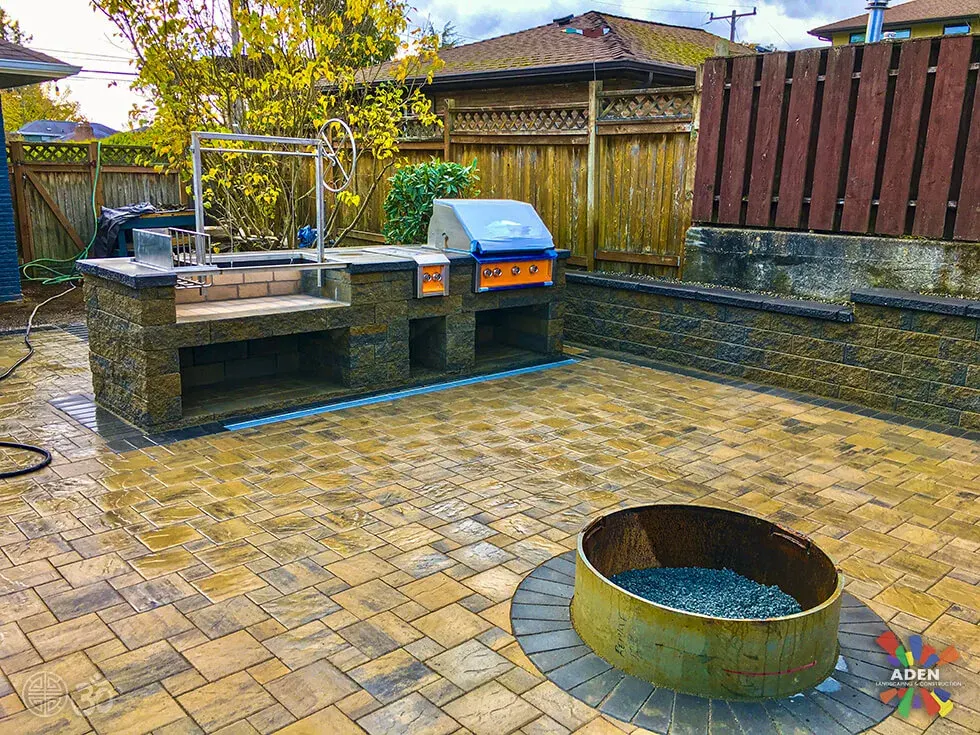
Two built-in grills, a run of stone-faced counter, and a copper fire bowl set into the paving. The gas line and the drainage went in before a single paver did — they always have to.
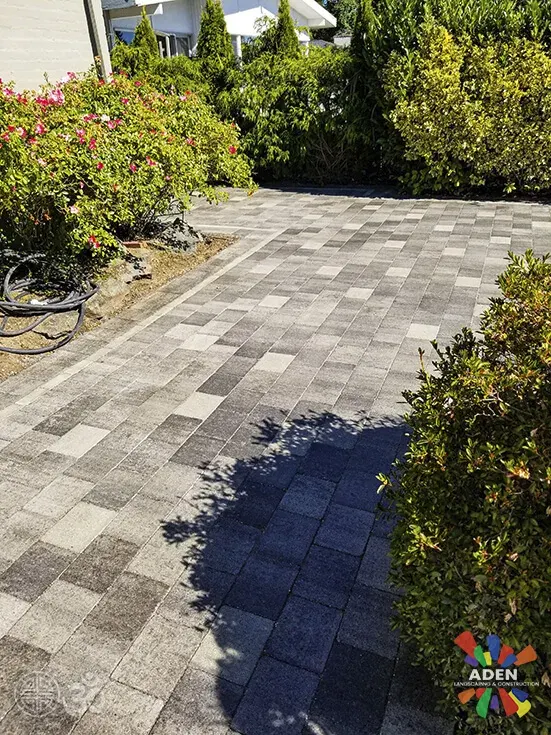 Driveway PavingView full size
Photographed before the edge planting went back, jointing sand still on the surface. The variation across the field is deliberate — units drawn from several pallets rather than one.
We come out, look at the ground, and put a fixed written price together. No deposit, and it does not change once agreed.
Free estimate
Three minutes on the form. We reply during office hours, Monday – Friday, 9:00 AM – 7:00 PM, and we come out and look at the site before quoting anything.
Or call (425) 533-9734
Thank you — we have your details. We reply during office hours, Monday – Friday, 9:00 AM – 7:00 PM. If it is urgent, call (425) 533-9734.