
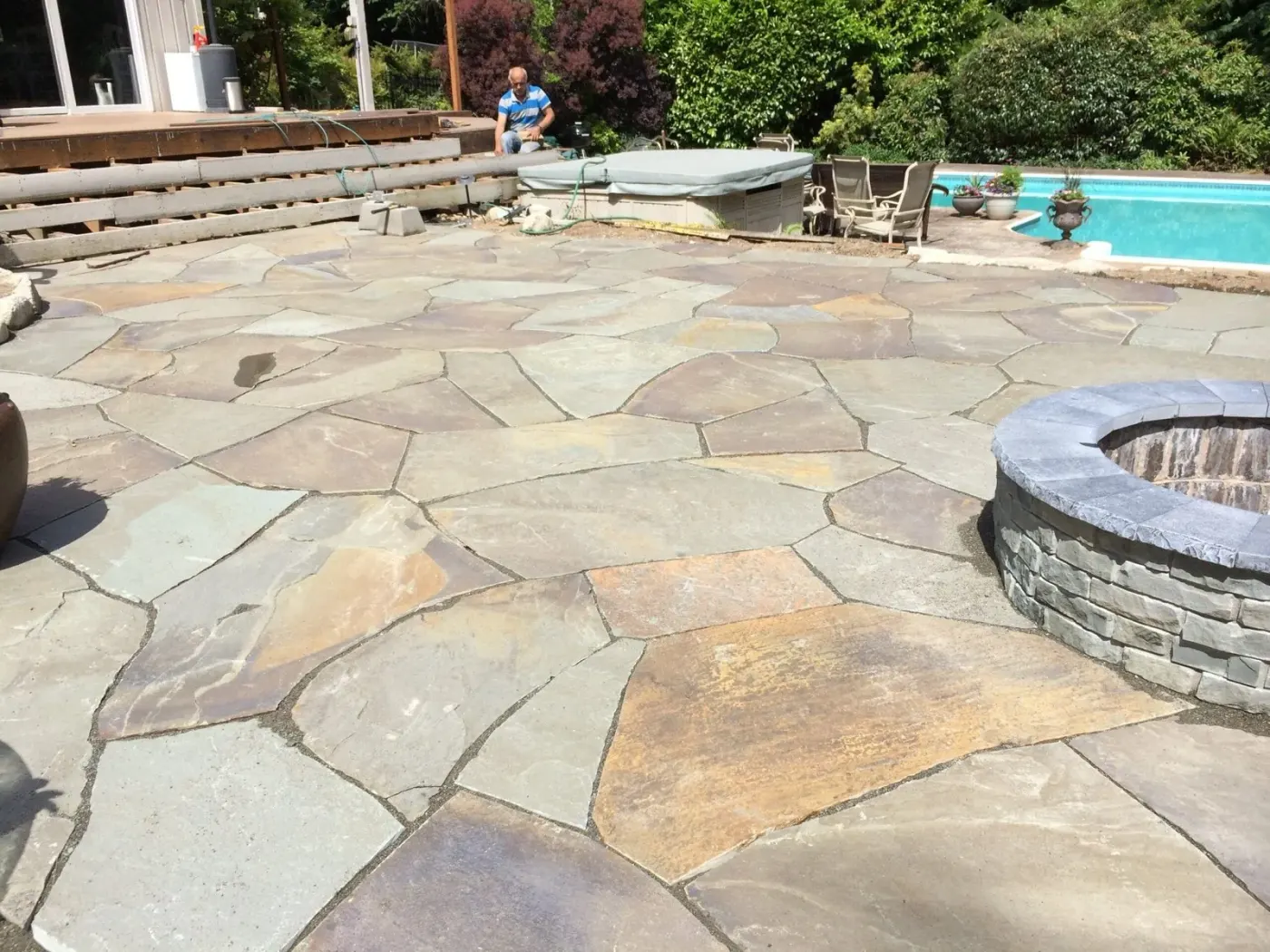
 FlagstoneView full size
Flagstone terrace around a hot tub
Irregular flagstone fitted around an existing hot tub and a new fire pit.
No down payment. You pay when the project is finished.
Monday – Friday, 9:00 AM – 7:00 PM · Capitol Hill, Seattle
Service area
Wedgwood has the flattest, most regular lots in Seattle and, as a direct consequence, some of the worst-draining gardens. Flat ground on glacial till gives water nowhere to go: it saturates the shallow topsoil and then sits there from November until the spring. Most of the work we do here starts with fixing that, because a play lawn, a patio or a turf area built on ground that holds water will not stay good. Once it drains, these are among the easiest gardens in the city to build in — level, accessible, regular in shape, and big enough to do more than one thing with.
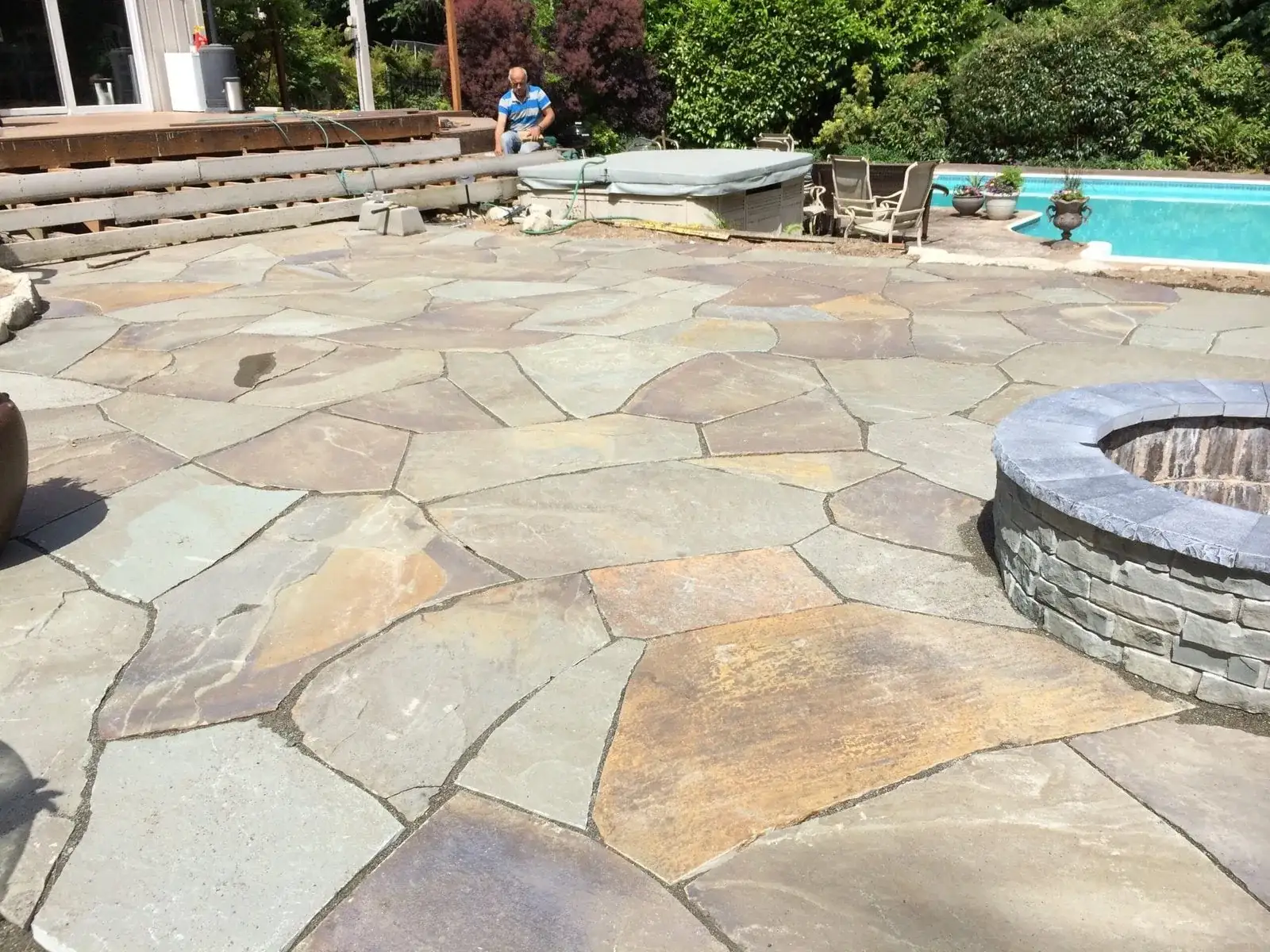
Irregular flagstone terrace fitted around a hot tub and a circular fire pit in a Wedgwood garden
What we plan around here
Wedgwood is family houses on flat rectangles, and flat ground on glacial till is the worst drainage combination in Seattle — water has nowhere to run, so it simply sits. That is why so much of the work here starts underground before it becomes a lawn, a play area or a patio. The second Wedgwood characteristic is that these lots are large enough to want zoning: a single 40-by-40 expanse of grass is a garden nobody uses, and splitting it into a paved area, a play lawn and real planting depth almost always makes it feel bigger.
What we build in Wedgwood
Serving Wedgwood and surrounding neighbourhoods
A nineteen-foot glacial erratic left in the middle of the neighbourhood — the most literal reminder available that this ground was delivered by an ice sheet.
The neighbourhood's open space, and a good demonstration of how flat north-end ground behaves after a week of rain.
The regional trail along the neighbourhood's southern edge, connecting Wedgwood to the lake and the campus.
Wedgwood · View Ridge · Hawthorne Hills · Bryant · Ravenna edge · Meadowbrook edge
98115
Recent work
FlagstoneView full sizeIrregular flagstone fitted around an existing hot tub and a new fire pit.
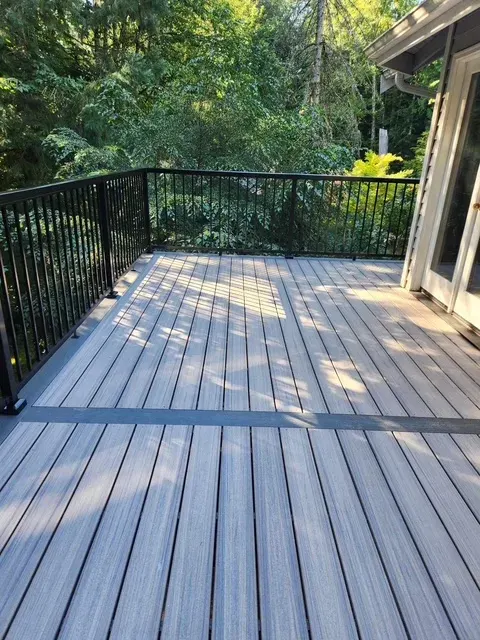 DeckingView full size
A darker inlaid board breaks the run and hides the joint where two board lengths meet — the detail that decides whether a large deck looks made or merely covered.
Local questions
Something specific to your street? Call (425) 533-9734 — we would rather look at it than guess.
Because slope gives water somewhere to go and flat ground does not. Under Wedgwood is glacial till, a compacted layer water moves through very slowly, covered by a relatively shallow topsoil. On a sloped lot, surface water at least runs off. On a flat Wedgwood rectangle it saturates the topsoil and stays until it evaporates, which between October and March it largely does not. The fix is a drain cut to a consistent fall and routed somewhere it can actually discharge — usually a lower point at the edge of the property or a connection at the street — often paired with a slight regrade so the ground itself carries water away from the house.
On a natural lawn, realistically no — and that is the single most common reason Wedgwood families call us. From November a lawn on undrained till is saturated, so it compacts under use, the grass thins, and by February the play area is bare mud that comes into the house. Two things change it. Drainage under the lawn is the first and it improves a real lawn substantially. Where the lawn is genuinely a play surface used year-round, artificial turf on a proper drainage base with a shock pad underneath is the specification that works, and it is one of the few products that performs all twelve months in this climate.
Divide it. The instinct on a 40-by-40 rectangle is to lay the whole thing to lawn, and the result is a garden that looks large from the window and gets used for about six weekends a year. Splitting it into a defined paved area sized properly for a table and chairs, a lawn or turf area smaller than you would guess, and planting deep enough to give the boundary structure consistently makes the space feel bigger and be used far more. On these lots there is also room for the thing most Seattle gardens cannot fit — a genuine route through the garden rather than just an edge around it.
They are a constraint to design around rather than a problem in themselves. The established north-end streets carry large maples, cedars and Douglas firs whose root systems run considerably wider than the canopy suggests, and excavating a patio base through a major root plate can kill a tree slowly enough that nobody links the two. Where a tree matters we shift the layout, reduce the excavation depth, or move the hard surface outside the critical root zone. The other side of it: where a tree is already in decline, taking it out before the hardscape goes in is much cheaper than getting equipment back over a finished patio later.
We come out, walk the property, look at the grade and the drainage, and put a written price together. No deposit, and it does not change once agreed.
Nearby
Gentler than the rest of Seattle. Broad flat platforms around Green Lake, Wedgwood and Maple Leaf, with real grade at the ravine edges and toward the Sound.
15–25 minutes from Capitol Hill
Gentle and rolling, falling steadily toward Union Bay and Lake Washington. No severe grade, which is unusual for a Seattle waterfront-adjacent neighbourhood.
15–25 minutes from Capitol Hill

Flat around the lake basin itself, rising to genuine grade on the Phinney Ridge side to the west and toward Maple Leaf to the north-east.
15–25 minutes from Capitol Hill
Seven hills and then some. Grade changes of 20–40% inside a single lot are ordinary in Queen Anne, Magnolia, Mount Baker and West Seattle.
Base of operations — Capitol Hill
Steep and wooded. The city falls from the upland down to Lake Washington through a series of ravines, and level ground is genuinely scarce.
30–40 minutes from Capitol Hill via I-5
Free estimate
20–30 minutes from Capitol Hill from our Capitol Hill base. Three minutes on the form and we will come out and look at it properly.
Or call (425) 533-9734
Thank you — we have your details. We reply during office hours, Monday – Friday, 9:00 AM – 7:00 PM. If it is urgent, call (425) 533-9734.