
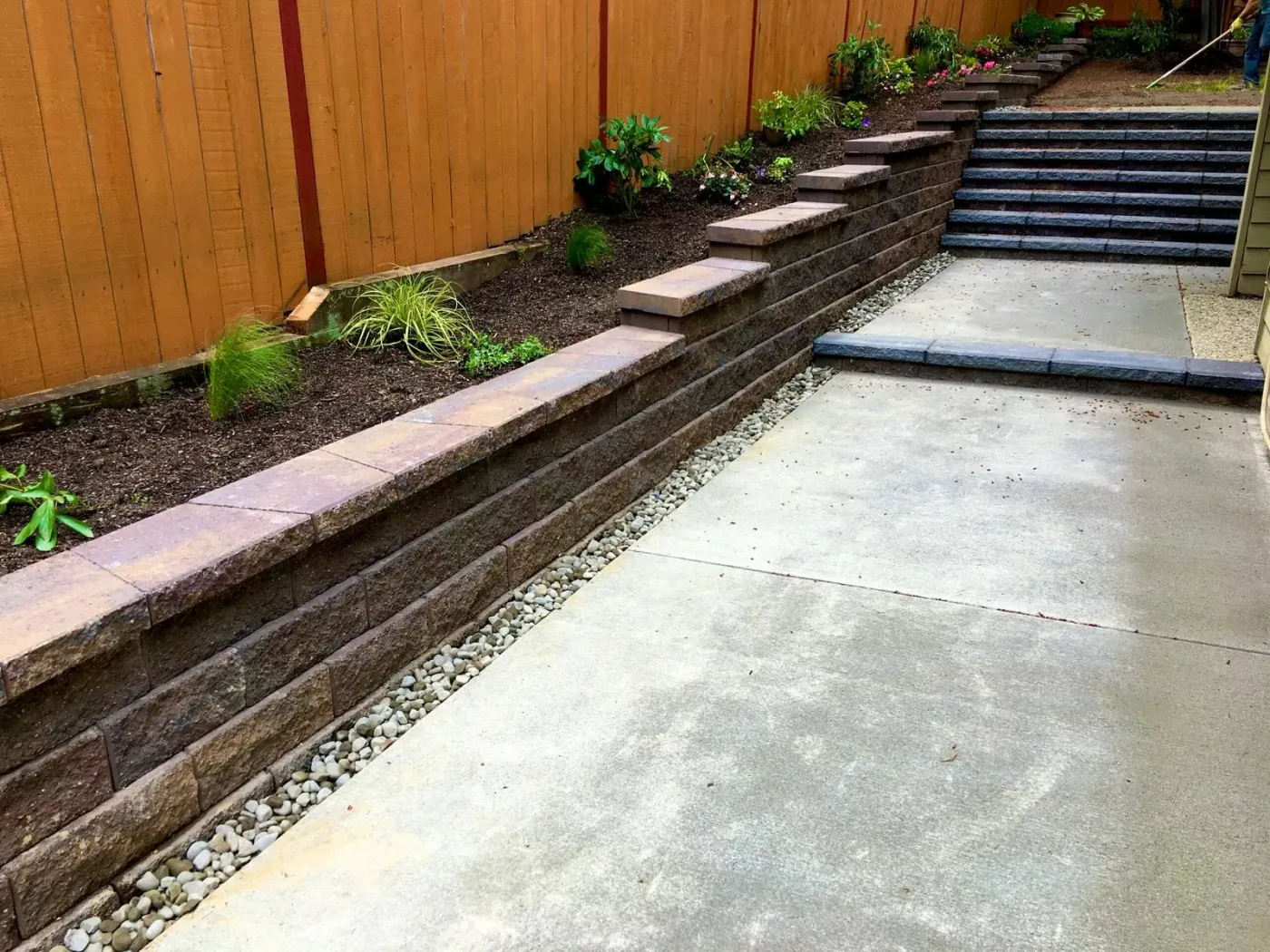
 Retaining WallsView full size
Terraced walls on a sloped lot
Two tiers of block wall with steps between them, turning a bank into planting beds and a level path.
No down payment. You pay when the project is finished.
Monday – Friday, 9:00 AM – 7:00 PM · Capitol Hill, Seattle
Irrigation · Sammamish
Sammamish has the largest lawns on this list, and a large lawn is by a distance the biggest consumer of water in any garden — which makes zoning and scheduling matter more here than anywhere. The plateau adds a specific complication that catches people out: this ground holds water for months of the year, so a garden that is saturated in February can still be genuinely dry in August, and a system set up by someone who visited in one season will be wrong in the other. The supply is its own district too — the plateau is served by Sammamish Plateau Water rather than by a city utility.
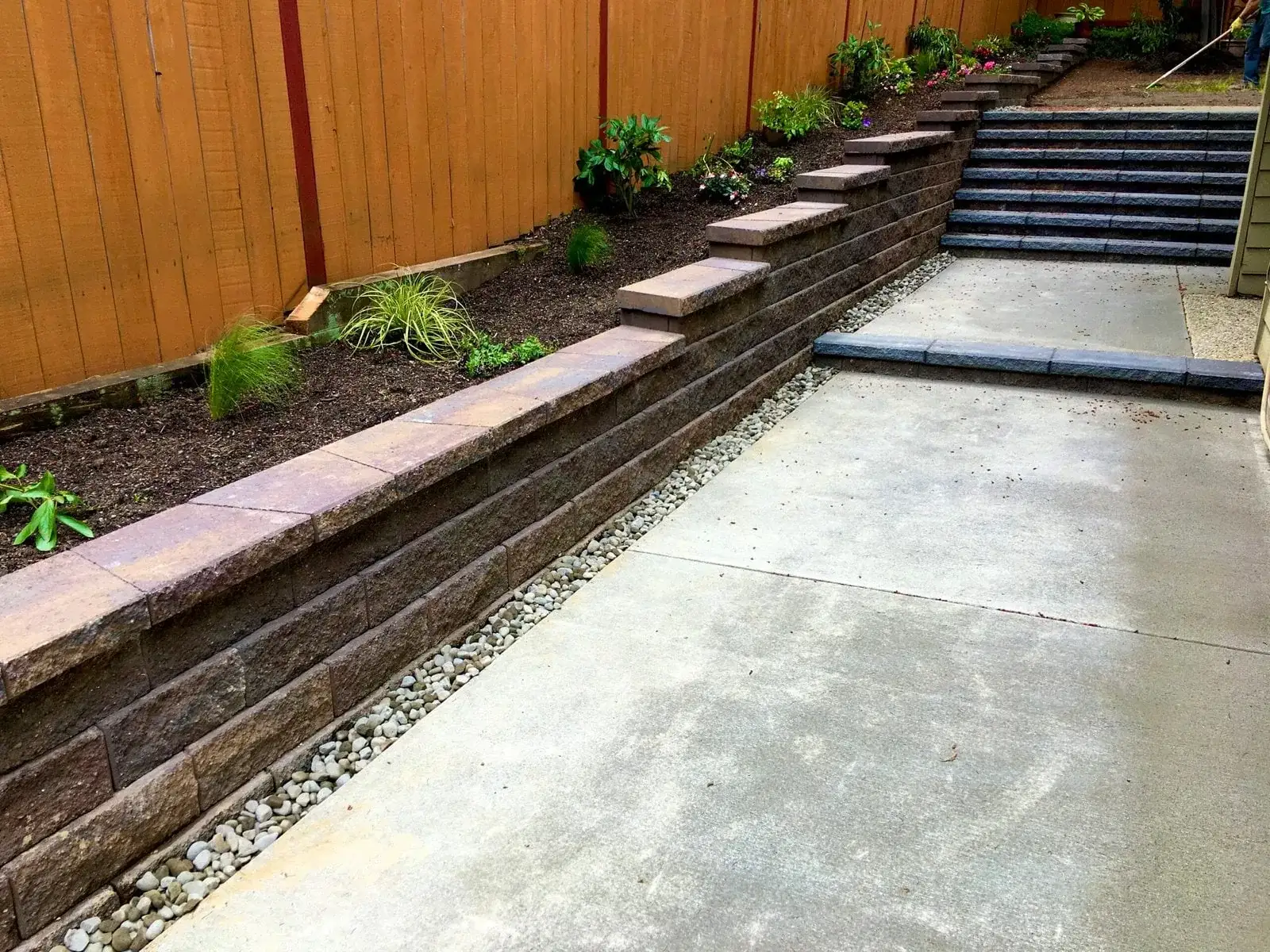
Two-tier block retaining wall with stone steps and new planting on a sloped Sammamish side yard
What we get called about
Sammamish has the big flat-ish lots that most of this market does not, and the catch that comes with them: a plateau holds water rather than shedding it, and seasonally saturated pockets turn up in places that look perfectly ordinary in July. That makes drainage the first question on a surprising number of these properties. The second Sammamish fact is HOA density — Klahanie, Trossachs, Sahalee and most newer developments have architectural standards that apply to fencing, materials and front-of-house work, so approval is a scheduling item on nearly every project.
Worth knowing in Sammamish
Do not size the system from a February walk round. Plateau ground is saturated in winter and dry by August, and a system specified on the assumption that this garden is always wet will leave a large lawn stressed in exactly the weeks it is being looked at.
The method
The sequence does not change between neighbourhoods — what changes is the ground it is applied to. Full detail on the irrigation service page.
Everything downstream depends on this. A design drawn without knowing what the supply actually delivers produces zones that cannot run properly, and it is the most common fault in existing systems.
Lawn, beds, containers and any shaded area separated, because they want different volumes and different frequencies. This is where most retrofits earn their money.
Sprinkler spacing calculated for head-to-head coverage; drip laid to the planting rather than in a grid that ignores where the roots are.
Lines trenched to depth and sleeved under any hard surface. Where a patio or drive is being built at the same time, the sleeves go in then — it costs almost nothing and saves a great deal later.
Zones timed, seasonal schedule set, and you shown how to adjust it. A system nobody knows how to change gets left on the install setting for a decade.
What it costs in Sammamish
Sammamish systems sit at the upper end of $3,000 to $9,000, and the reason is zone count rather than rate — a quarter-acre garden with lawn, deep beds and containers genuinely needs more circuits than a suburban lot. Access is excellent so trenching is efficient, which offsets some of it.
You pay after the project is fully completed.
The estimate you sign is the price you pay.
Spread the cost with no interest.
Covers hardscape work; vegetation excluded.
Local questions
General questions about this service are on the service page. These are the ones that only come up here.
Because the two conditions happen at opposite ends of the year and neither cancels the other. This ground holds water from October to March because it is level and sits over glacial till — that is a drainage problem. By late July the same lot has dried out, and a large lawn on it will be stressed within a fortnight of the rain stopping. The garden genuinely needs both: drainage to make it usable in winter and irrigation to keep it alive in August. Designing them together, in the same trenches, is considerably cheaper than as two projects.
Enough that it is the single item worth getting right, and enough that zoning it properly pays for itself. Lawn is the highest-consumption element in almost any garden, and on a quarter-acre plateau lot it can dominate summer usage entirely. The efficiency levers are head-to-head spacing so no area needs over-watering to compensate for a dry patch, matched precipitation rates across each zone, early-morning scheduling to limit evaporation, and weather-responsive control. Those are design decisions rather than habits, which is why an old system rarely improves without being reworked.
Sammamish Plateau Water, a water and sewer district rather than a city utility department, and itself a member of the Cascade Water Alliance regional arrangement. For a homeowner the practical relevance is that conservation programmes, rate structures and any restrictions are administered separately from a city utility. Because those change year to year, we design for lower consumption directly — proper zoning, drip on beds, weather-responsive control — rather than relying on any particular programme being available when you install.
On a plateau lot it is a serious option and it changes the irrigation picture entirely — turf needs no water at all beyond an occasional rinse. Whether it is right depends on how the space is used and how much of the lawn is genuinely needed. What we would usually suggest is not an either/or: turf the area that has to be usable in February and takes real wear, keep a smaller real lawn if you want one, and put the irrigation into the planted areas where it does the most good. That is frequently cheaper than either extreme.
Serving Sammamish and surrounding neighbourhoods
Pine Lake · Beaver Lake · Klahanie · Trossachs · Inglewood Hill · Sahalee
98074 · 98075
Recent work
Retaining WallsView full sizeTwo tiers of block wall with steps between them, turning a bank into planting beds and a level path.
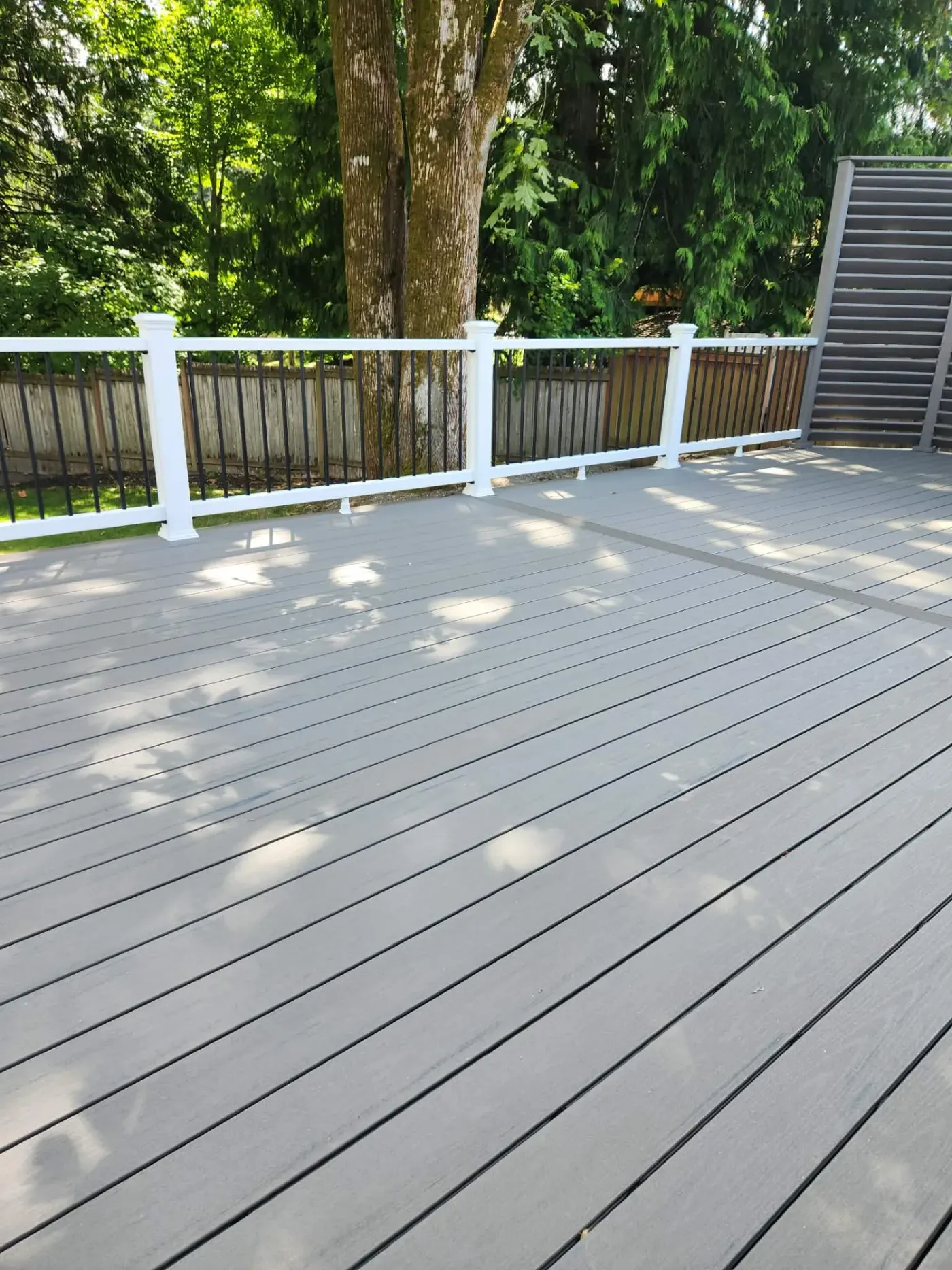 DeckingView full size
A big single-level deck sized for a table and still leaving room to walk around it, with white posts and black metal balusters picking up the trim on the house.
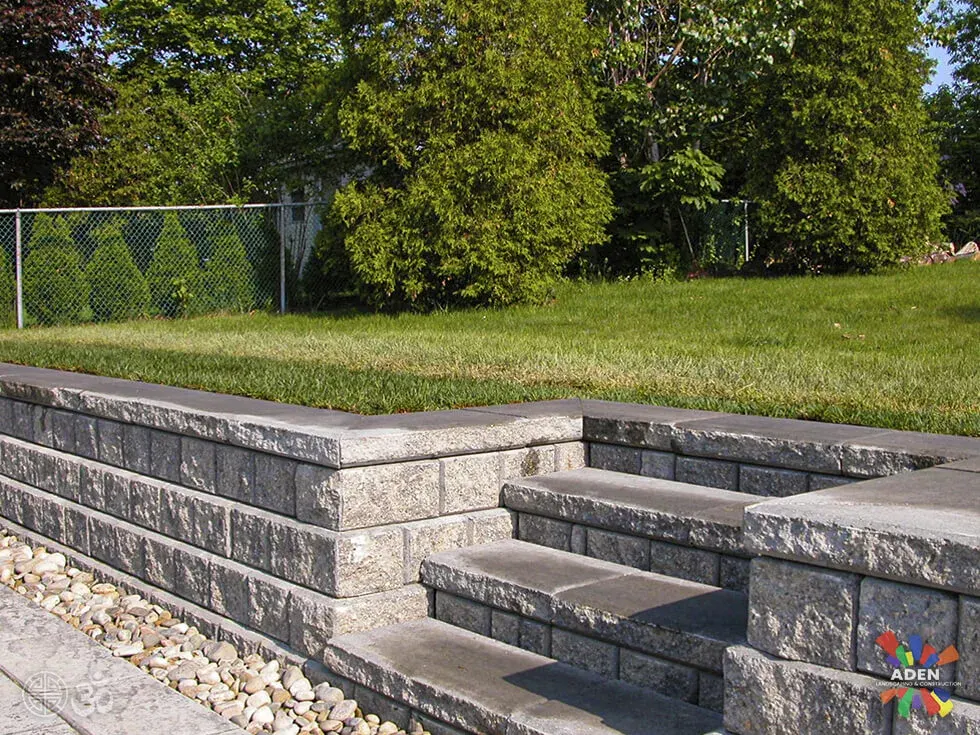 Retaining WallsView full size
The white rock along the toe is the part that decides whether this wall is still straight in ten years. Water gets a route out rather than somewhere to push.
 Outdoor LivingView full size
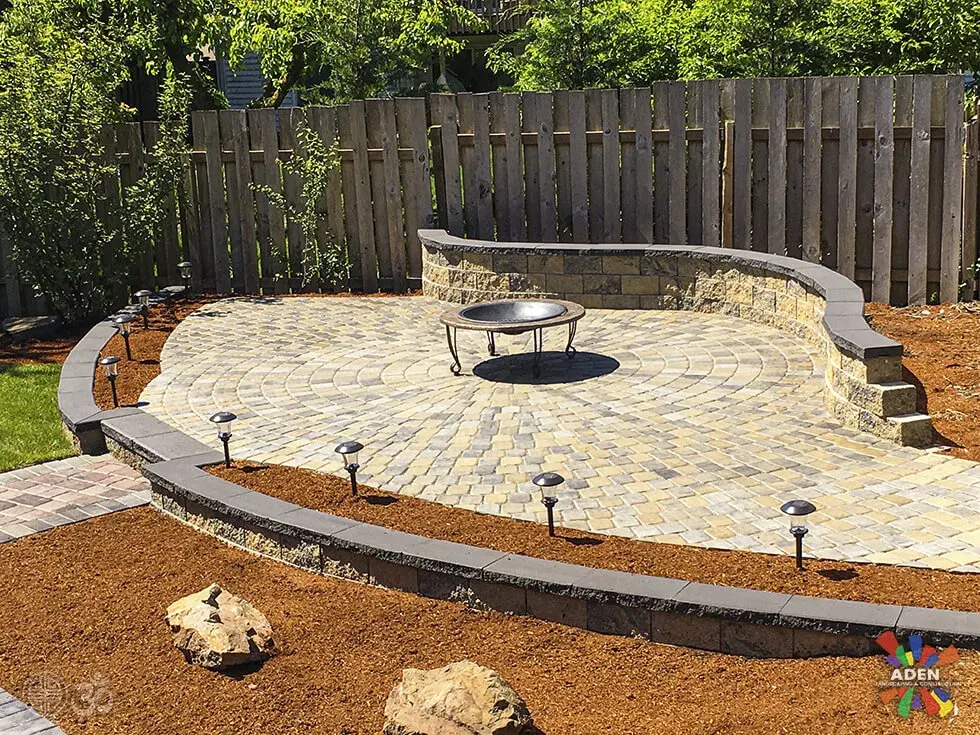
A circular paver terrace wrapped by a curved seat wall, lit at the edge and mulched beyond it. Every unit on that curve is cut on site; there is no kit for this shape.
We come out, look at the ground, and put a fixed written price together. No deposit, and it does not change once agreed.
Free estimate
Three minutes on the form. We reply during office hours, Monday – Friday, 9:00 AM – 7:00 PM, and we come out and look at the site before quoting anything.
Or call (425) 533-9734
Thank you — we have your details. We reply during office hours, Monday – Friday, 9:00 AM – 7:00 PM. If it is urgent, call (425) 533-9734.