
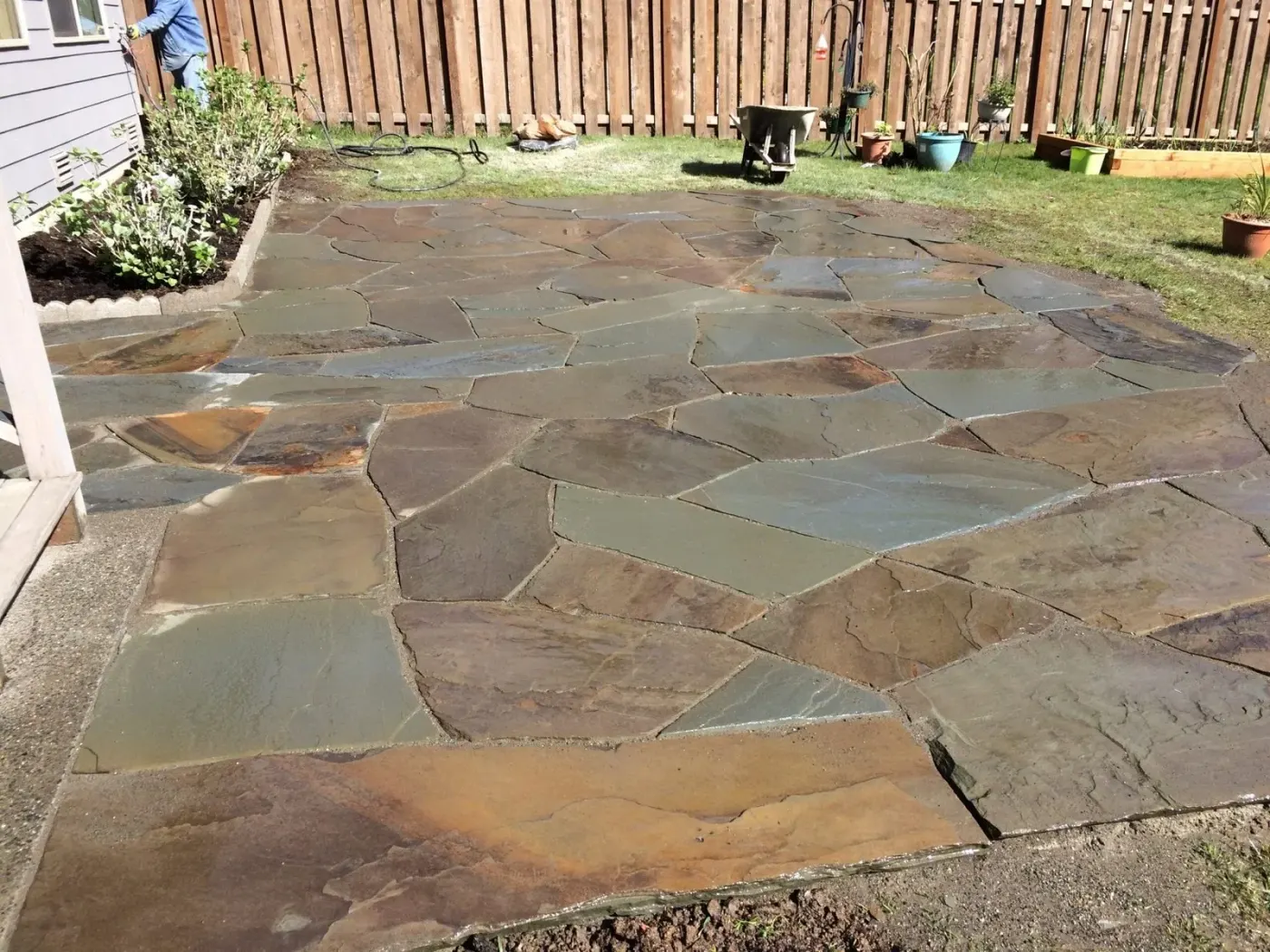
 FlagstoneView full size
Natural flagstone patio
Hand-fitted flagstone laid tight, replacing a tired lawn that never drained properly.
No down payment. You pay when the project is finished.
Monday – Friday, 9:00 AM – 7:00 PM · Capitol Hill, Seattle
Artificial Turf · Mercer Island
Mercer Island is where turf answers the question a lawn never could. These are the most heavily treed lots we work on, and under an established island canopy you have low light, acidic needle litter and soil that the trees dry out in summer — a combination almost no grass survives, which is why so many island lawns have been reseeded repeatedly with the same result. Turf is indifferent to all three. What it is not indifferent to is the excavation, and that is the island-specific constraint: a conventional turf base means removing six inches or more of soil across the area, which under a mature tree cuts straight through the root plate.
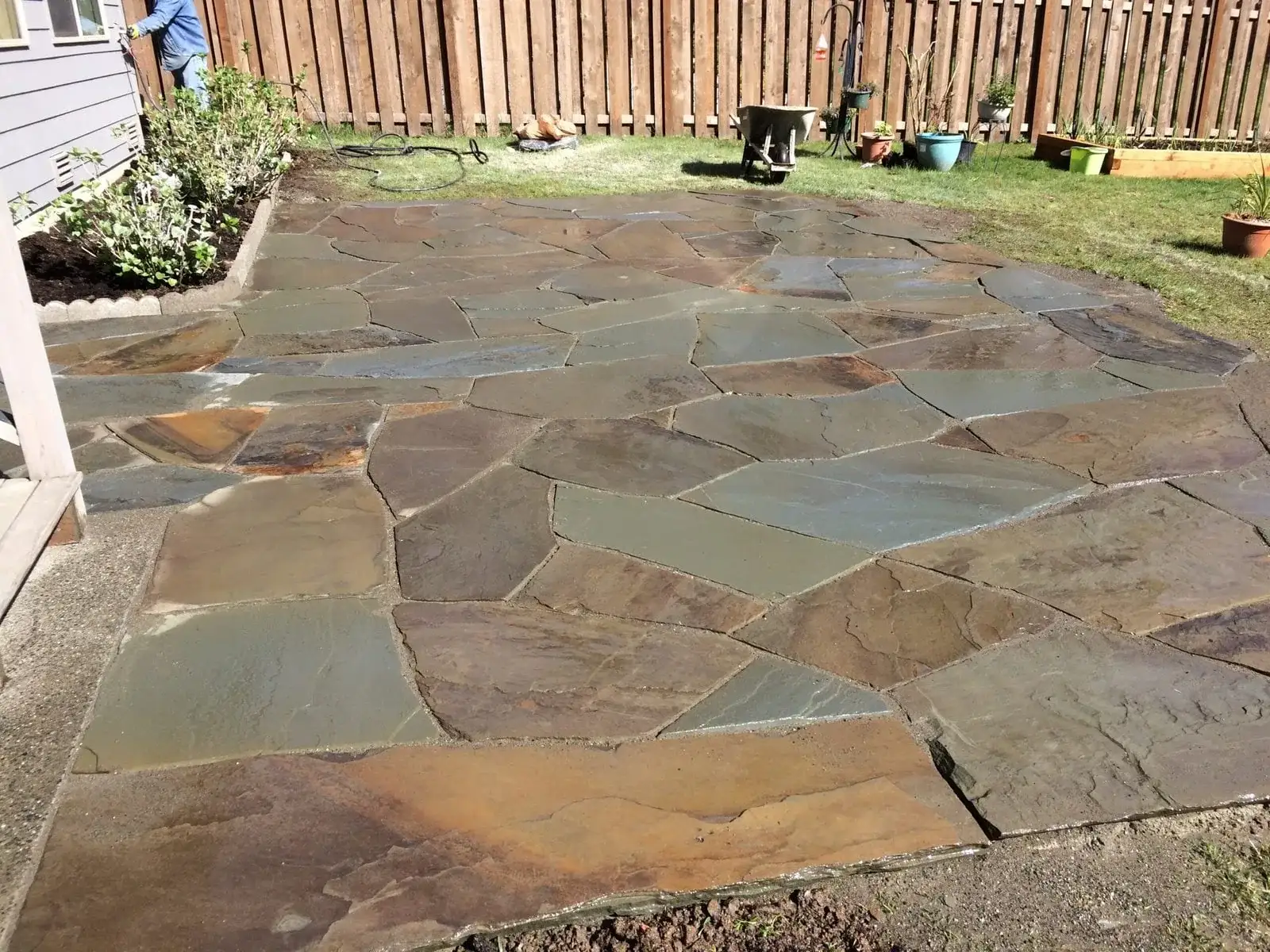
Hand-fitted natural flagstone patio in a fenced Mercer Island back garden
What we get called about
Mercer Island is large lots, mature trees and a shoreline slope on every edge, and the trees are the defining constraint. The city regulates removal on private property more tightly than most, and the canopy on these lots is dense enough that light and root plates govern where hard surfaces can realistically go. Toward the shoreline the ground steepens and slope stability becomes a design factor rather than a formality. Access is generally excellent, which is one reason island projects tend to be full renovations rather than piecemeal work.
Worth knowing on Mercer Island
The irony of turf on this island is that the places where grass fails most reliably are the places where a standard turf base does the most damage. Deep shade under an established fir or maple is exactly where a lawn will not grow — and it is exactly where six inches of excavation across the area severs a substantial share of the roots keeping that tree alive.
Most of those roots sit in the top twelve to eighteen inches of soil and spread well beyond the branch line. A tree that loses a significant share of them may take three or four years to decline, by which point nobody connects it to the landscaping. On this island that is also a regulatory question as well as an arboricultural one, since the city regulates work affecting trees on private property more protectively than most jurisdictions here.
There are three workable responses. Shift the turf area outside the critical root zone, which costs nothing at the design stage. Use a shallower build-up close to the tree, trading some base depth for a much smaller root impact — acceptable on a lightly used area, less so on a play surface. Or leave the ground under the canopy as woodland planting, where sword fern, salal and evergreen huckleberry thrive in exactly the conditions defeating your lawn, and put the turf where it is genuinely needed. That third option is frequently the better garden.
The method
The sequence does not change between neighbourhoods — what changes is the ground it is applied to. Full detail on the artificial turf service page.
Light, drainage, use and how much of the garden it should cover. A shaded 200-square-foot back garden and a sunny 1,200-square-foot play lawn are different recommendations.
Existing lawn and topsoil out, down to a depth that leaves room for a real base rather than a skim.
Crushed rock in compacted lifts, graded to a fall. On lots where water arrives from uphill this stage sometimes gains a drain before the turf goes anywhere near it.
Turf rolled out to relax, cut to the shapes, seamed, and fixed at every edge so nothing can lift.
Infill spread and brushed in to hold the pile up. This is what stops turf looking flattened after a year — it is not optional.
What it costs on Mercer Island
Island access is excellent and the run from our Capitol Hill base is short, so the labour is efficient and installs sit mid-range at $13 to $24 per square foot. What adds cost is working around trees — hand excavation within root zones, adjusted layouts and shallower base construction where a root plate cannot be cut are all slower than a machine cutting a straight excavation.
You pay after the project is fully completed.
The estimate you sign is the price you pay.
Spread the cost with no interest.
Covers hardscape work; vegetation excluded.
Local questions
General questions about this service are on the service page. These are the ones that only come up here.
Frequently yes, and it is the most common reason we are asked about it here. Under an established canopy you have three problems at once — low light, acidic needle and leaf litter, and soil the trees dry out through the summer — and grass needs all three to be different. Turf is unaffected by any of them and stays green in February. The qualifier is the base excavation and its effect on the tree roots, which is what we look at before recommending it, because on some lots the honest answer is woodland planting rather than turf.
Sometimes, with a modified approach, and it needs establishing before the layout is fixed. A conventional base means removing six inches or more of soil across the whole area, and under a mature tree that cuts through a root plate largely sitting in the top twelve to eighteen inches and extending well beyond the canopy. The alternatives are shifting the area outside the critical root zone, or a shallower build-up that trades base depth for a much smaller root impact. The city's tree provisions may also bear on significant excavation within a root zone.
It needs clearing, and on a wooded island lot that is the main maintenance task rather than an occasional one. Needle and leaf litter left on turf mats down, holds moisture against the surface and eventually supports algae and moss growth on top of the pile — which is not a fault in the turf but does make it look tired and feel slippery. Clearing it a few times through the autumn with a blower or a stiff brush takes minutes and keeps the surface right. It is worth factoring in honestly when comparing turf with a lawn under the same trees.
Yes, provided the base is built for it — and shaded island ground is exactly the case that needs it. A closed canopy keeps sun and wind off the soil, so ground under it dries very slowly and can remain saturated for weeks after rain stops. Turf backing passes water freely, so all of it reaches the base, and the base has to move it somewhere rather than hold it. That means a genuinely free-draining build-up graded to a fall with a real outfall, not simply a levelling layer over the existing wet ground.
Serving Mercer Island and surrounding neighbourhoods
North End · East Seattle · First Hill · Mercerwood · Island Crest · South End
98040
Recent work
FlagstoneView full sizeHand-fitted flagstone laid tight, replacing a tired lawn that never drained properly.
 Retaining WallsView full size
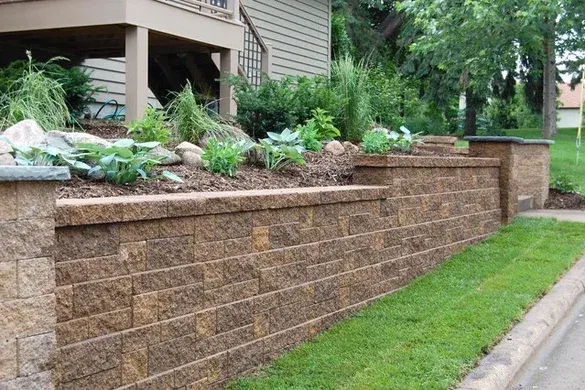
A long run of split-face block turning the fall between house and street into a raised bed at standing height, capped flat so the whole length reads as one line.
 Retaining WallsView full size
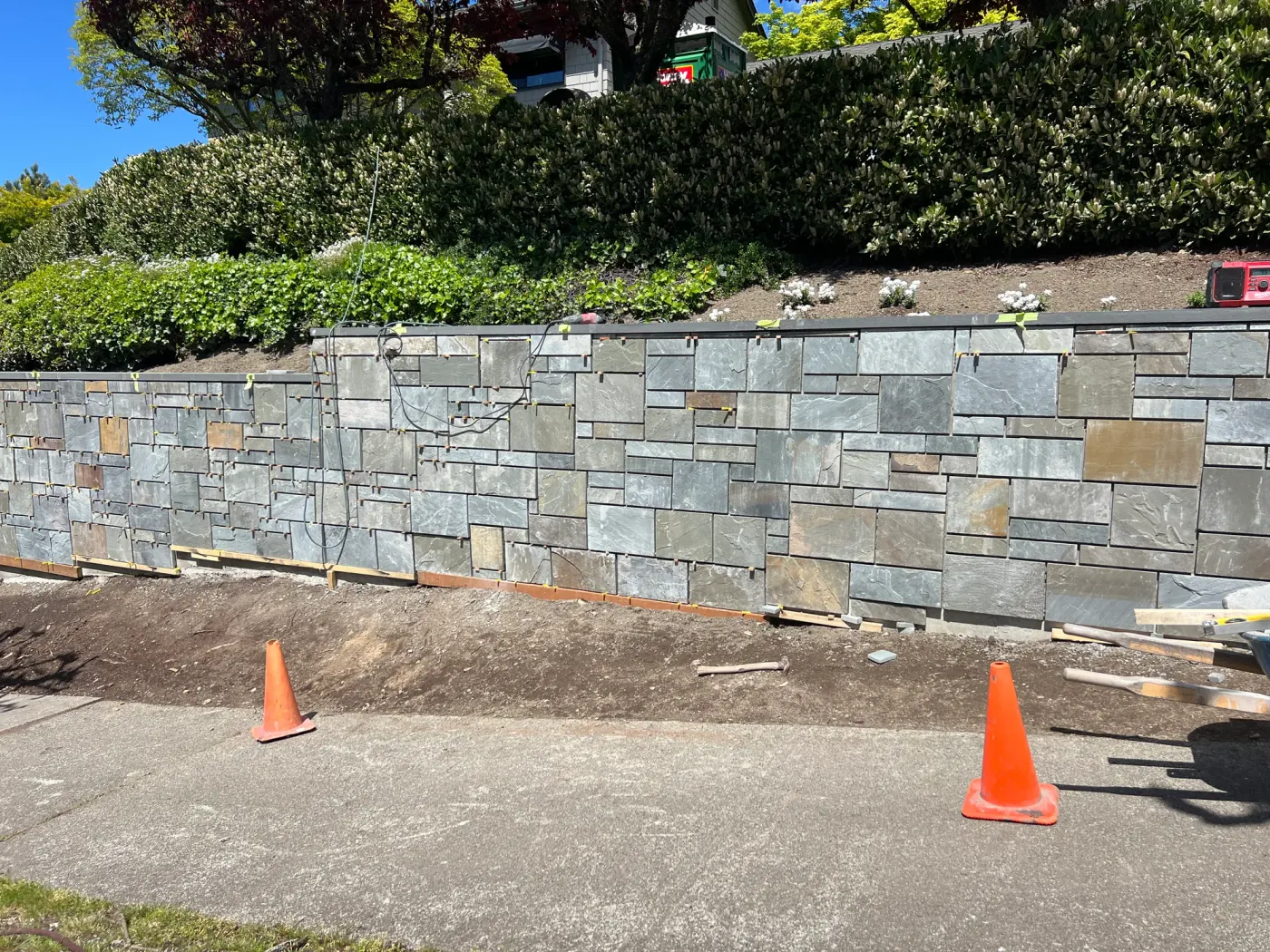
A long frontage wall going up in cut stone, cones out and the base course still showing. The bed above it was regraded to drain towards the street rather than back into the wall.
 Paver PatioView full size
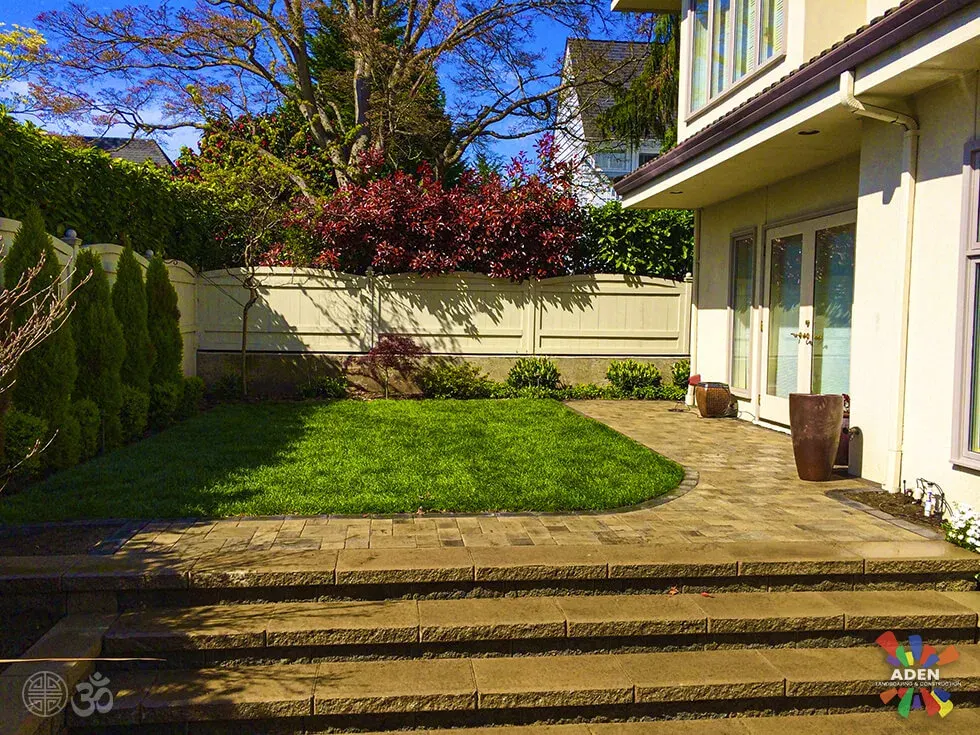
A wide run of paver steps down from the house to a terrace that stops where the lawn begins. Not every garden wants paving all the way to the fence.
We come out, look at the ground, and put a fixed written price together. No deposit, and it does not change once agreed.
Free estimate
Three minutes on the form. We reply during office hours, Monday – Friday, 9:00 AM – 7:00 PM, and we come out and look at the site before quoting anything.
Or call (425) 533-9734
Thank you — we have your details. We reply during office hours, Monday – Friday, 9:00 AM – 7:00 PM. If it is urgent, call (425) 533-9734.