
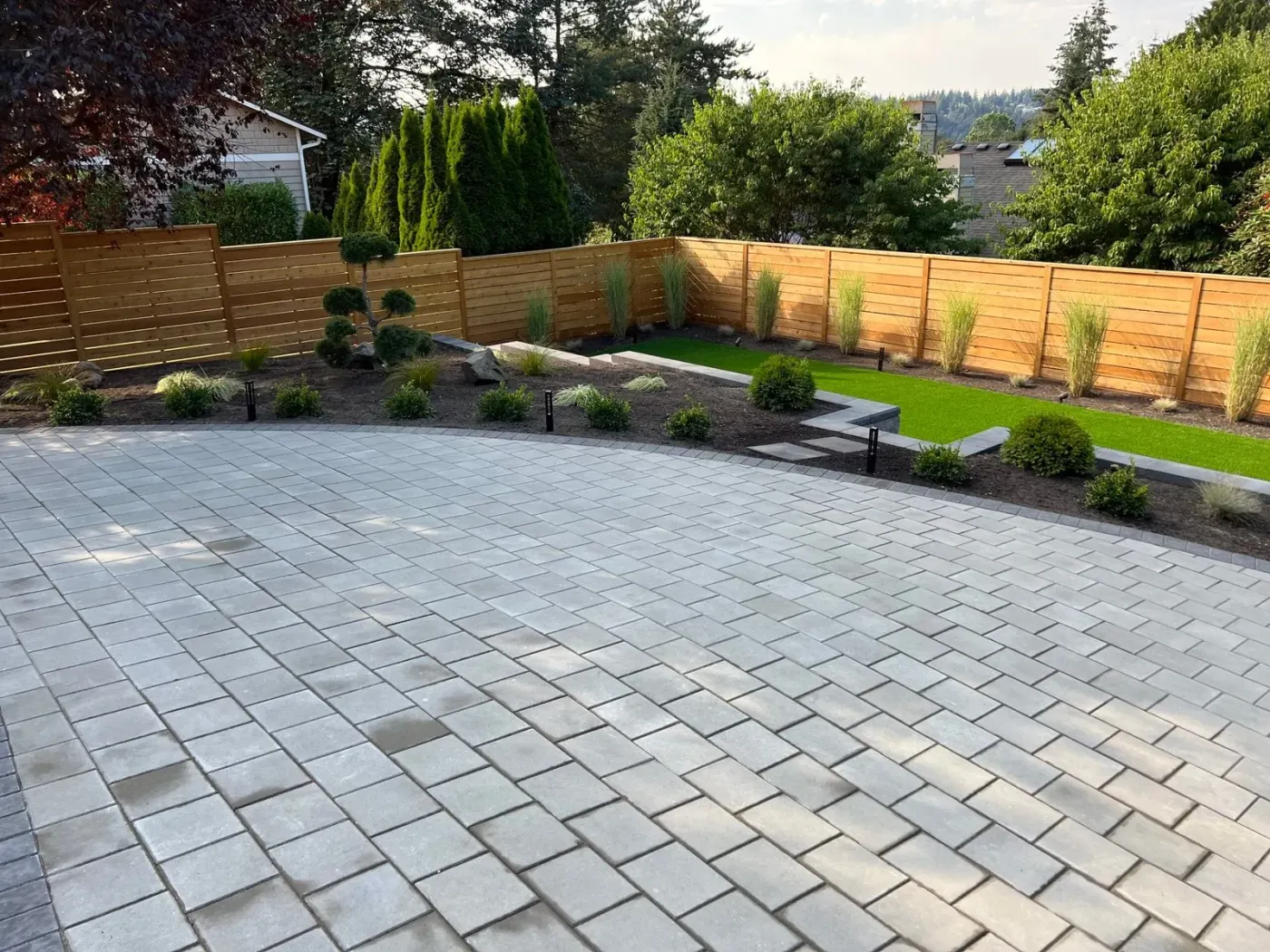
 Paver PatioView full size
Full backyard rebuild in pavers and turf
Patio, turf lawn, planting beds and a new cedar fence — the whole yard rebuilt as one project.
No down payment. You pay when the project is finished.
Monday – Friday, 9:00 AM – 7:00 PM · Capitol Hill, Seattle
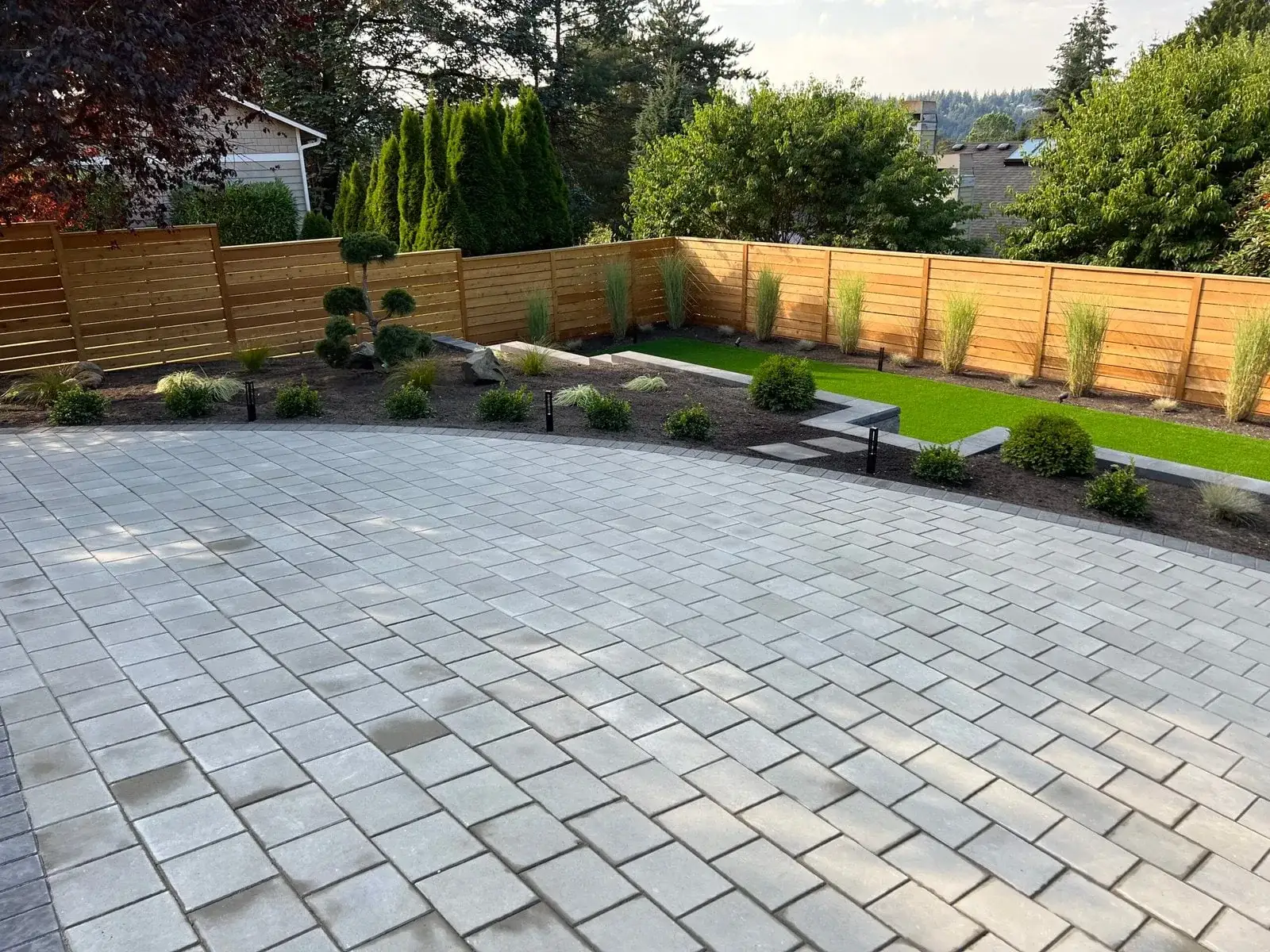
Paver Patios · Kirkland
Kirkland is the area on this list where a patio most often has to be built rather than simply laid, and the fall toward Lake Washington is why. On the Houghton and downtown streets closest to the water the ground drops steadily across the back of the lot, so the flat area you want does not exist until someone makes it — which means a retaining edge, a drainage route behind it, and imported fill to bring the level up. That work is invisible in the finished photograph and is most of the cost. The practical consequence is that terracing beats levelling here: two smaller paved areas at different heights, connected by steps, need a fraction of the retaining and fill that one large level terrace at the same elevation would. Up on Rose Hill and Finn Hill the ground flattens, machine access improves, and the same patio costs meaningfully less for reasons that have nothing to do with the paving itself.
Large paver patio with artificial turf lawn, new planting beds and horizontal cedar fencing in Kirkland
What we get called about
Kirkland is a lake city built on a slope, and the closer to the water a property sits the more the fall dictates the work. Downtown and Houghton lots frequently need terracing and stairs to produce anything level, and on the tighter waterfront streets the access constraints look more like Seattle than like the rest of the Eastside. Up on Rose Hill and Finn Hill the lots open out, access improves and the work becomes about making a large space do something. The low ground around Juanita Bay is the drainage exception and needs checking.
Worth knowing in Kirkland
On a Kirkland view lot, sit down before you settle the level. What you can see from a chair on a terrace and what you can see standing on it are different views, and a surface set even a foot lower can put a fence line straight across the water.
The method
The sequence does not change between neighbourhoods — what changes is the ground it is applied to. Full detail on the paver patios service page.
Before anything is dug we work out where the water is going to go. A patio should shed water away from the house at a fall you cannot feel underfoot but the rain can find.
Deeper than most people expect — the finished surface is the top of a build-up, not a layer laid on the lawn.
Crushed rock in compacted lifts. This is where the job is won or lost and it is the layer a cheap quote thins down.
A consistent bedding course over the compacted base, screeded rather than eyeballed.
Units laid to the pattern, cut cleanly at the edges, and locked in with edge restraint so the field cannot creep outward over time.
Jointing sand vibrated in so the surface acts as one interlocked field rather than a collection of loose units.
What it costs in Kirkland
Paver patios run $20 to $50 per square foot here, and on the lake-slope streets the spread within that range is wider than anywhere else on this list. What moves it is not the paving specification, which barely changes — it is how much ground has to be held and how much fill has to be brought in before any of it can be laid. A flat Rose Hill garden sits near the bottom of the range. The same patio on a Houghton lot falling three feet across its width can sit near the top before the first paver arrives. We price the retaining and the fill as separate lines so you can see which half of the number is the surface and which half is the ground.
You pay after the project is fully completed.
The estimate you sign is the price you pay.
Spread the cost with no interest.
Covers hardscape work; vegetation excluded.
Local questions
General questions about this service are on the service page. These are the ones that only come up here.
Two, in almost every case where the ground falls more than about eighteen inches across the area you want. The reason is arithmetic rather than taste: holding a level surface out over a slope means a retaining edge whose height — and therefore whose cost — grows with the distance you carry that level. Splitting the same square footage into two terraces a step apart halves the height each edge has to hold and roughly halves the imported fill. It also usually produces a better garden, because two defined areas at different heights give you somewhere to eat and somewhere to sit rather than one large paved rectangle. The case for a single level is a genuinely large table, or a household where steps are a problem — both good reasons, and we price it that way when they apply.
Behind the retaining edge, into a drain, and out to a route that existed before we arrived — and settling that last part is the first thing we do rather than the last. A terrace cut into a Kirkland slope interrupts water that was previously running down that slope, so the patio has to give it a new path or it will find one, usually through the fill and out of the face of the wall. That means a perforated pipe in free-draining rock behind the edge, wrapped in geotextile so the fines cannot silt it up, falling to somewhere real. On the lake-slope streets that is often the trickiest part of the design, because the natural destination is downhill and downhill is a neighbour. Getting it agreed at the estimate stage is considerably easier than getting it agreed after the first heavy autumn.
Yes, and a good share of our Houghton and downtown work is exactly that. Base rock, sand and pavers come in by barrow along a side return, through the house on floor protection, or occasionally by conveyor over a fence. What changes is time rather than feasibility — a patio that is a two-day build on a Rose Hill lot can run to four here. We walk the access route before quoting and price it as its own line, which sometimes makes our figure look higher than a bid from someone who has not yet worked out how the material is getting in.
On a Kirkland lake lot this is a real tension and it is worth deciding deliberately rather than by default. The view is generally west across the water, which is also where the afternoon and evening sun comes from — so the two frequently coincide, and that is a genuinely good outcome. Where they do not, our usual recommendation is two areas rather than one compromise: a smaller terrace positioned for the view and evening light, and a larger everyday surface closer to the house where the door is. Splitting the budget across two well-placed areas beats one large one in the wrong spot.
Serving Kirkland and surrounding neighbourhoods
Downtown Kirkland · Juanita · Rose Hill · Houghton · Bridle Trails · Totem Lake · Finn Hill · Kingsgate · Norkirk · Market · Highlands
98033 · 98034
Recent work
Paver PatioView full sizePatio, turf lawn, planting beds and a new cedar fence — the whole yard rebuilt as one project.
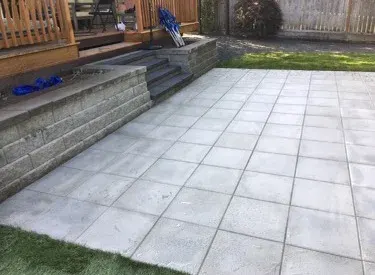 HardscapingView full size
Large-format slabs filling the dead ground under the deck, with a low wall holding the bank behind them.
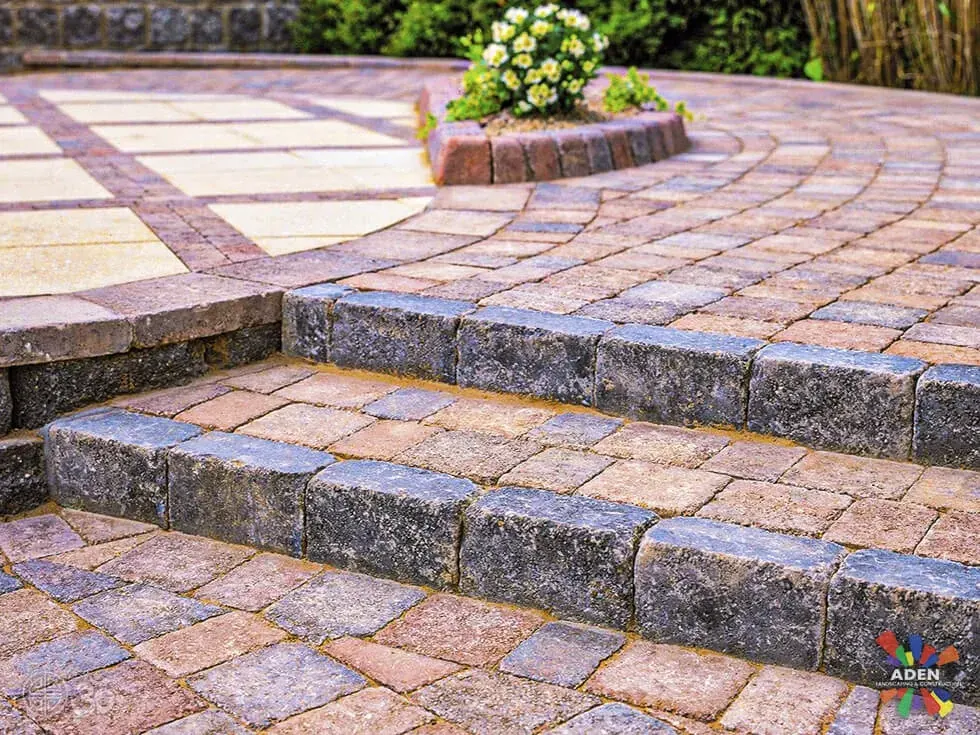 Paver PatioView full size
Close on the junction that decides whether a patio looks built or looks bought: step nosing, soldier course and field, all arriving on one line.
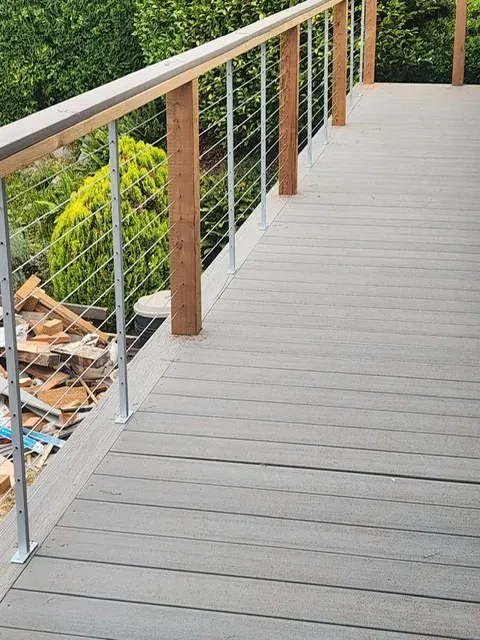 DeckingView full size
A raised walk connecting two levels of a narrow side garden. Cedar posts with stainless cable infill keep the hedge visible instead of walling it off behind balusters.
We come out, look at the ground, and put a fixed written price together. No deposit, and it does not change once agreed.
Free estimate
Three minutes on the form. We reply during office hours, Monday – Friday, 9:00 AM – 7:00 PM, and we come out and look at the site before quoting anything.
Or call (425) 533-9734
Thank you — we have your details. We reply during office hours, Monday – Friday, 9:00 AM – 7:00 PM. If it is urgent, call (425) 533-9734.