
 Design & BuildView full size
Paver terrace, block wall and turf lawn
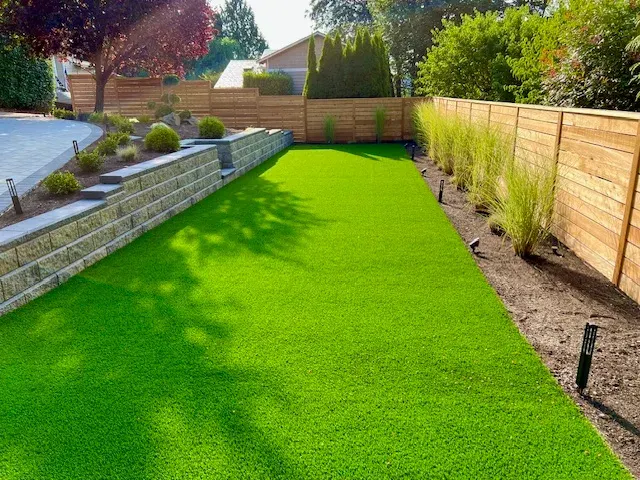
A sloping back garden cut into two usable levels — paver terrace at the top, level turf lawn below, and a block wall doing the work between them.
3 photos
No down payment. You pay when the project is finished.
Monday – Friday, 9:00 AM – 7:00 PM · Capitol Hill, Seattle
Retaining Walls · Bellevue
Bellevue walls fall into two very different categories, and the first thing we establish is which one you have. On the hill ground — Somerset, Newport Hills, the western flank of Cougar Mountain — the work is conventional slope retention on glacial till, with the advantage that most of these lots have a driveway a machine can operate from, so the cost per foot of face is substantially lower than the same wall in Seattle. On the low ground around Mercer Slough it is a different problem entirely. Peat and organic soils compress under load in a way till does not, which changes what a footing has to do and makes the consequences of an undersized one visible within a few seasons rather than a decade.
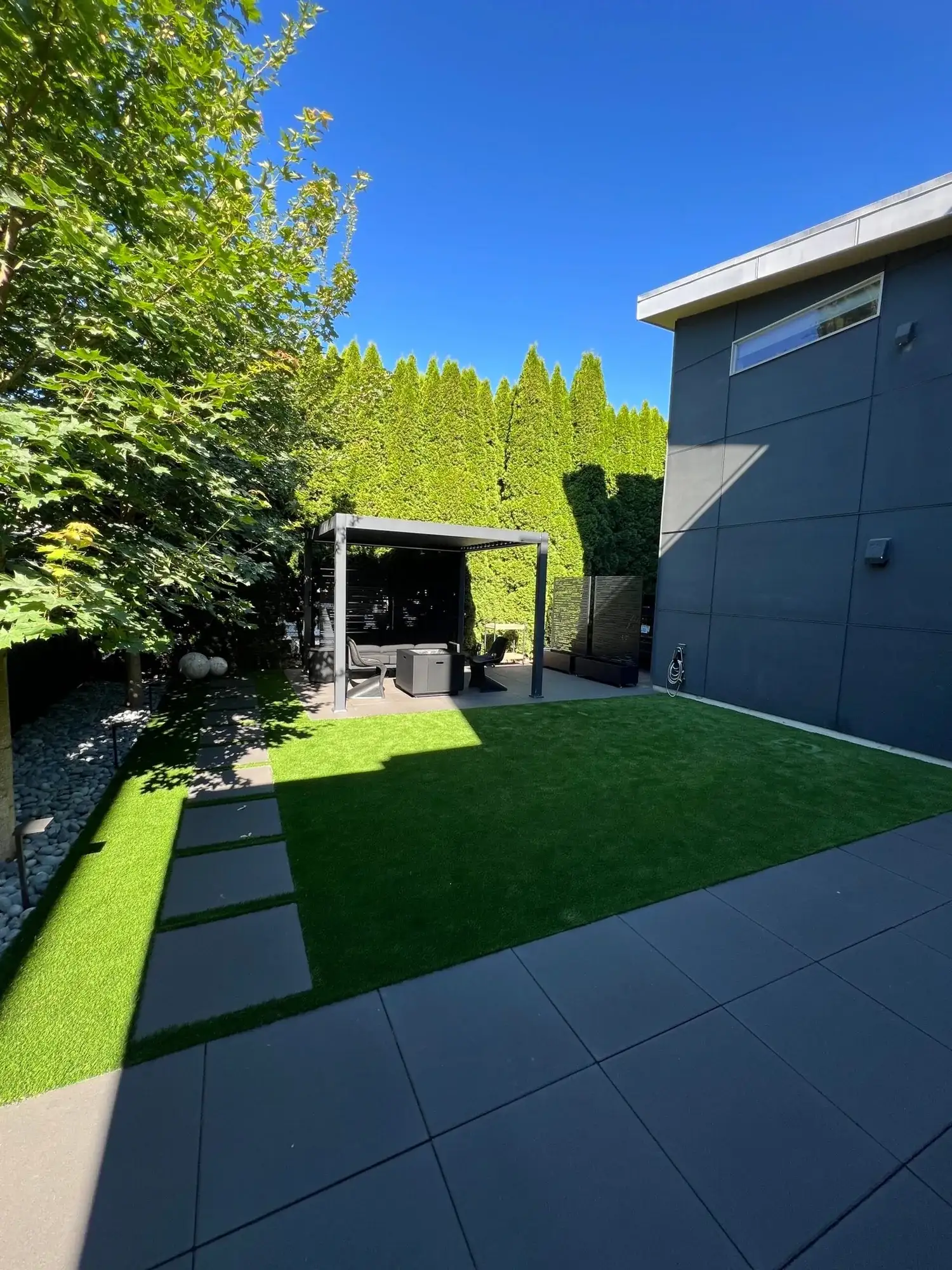
Large concrete paver planks set into an artificial turf lawn beside a dark modern house
What we get called about
Bellevue lots are larger than Seattle's and the access is usually far better — a driveway a machine can work from changes the cost per square foot of everything. What varies enormously here is the ground. A Somerset hill lot needs walls and slope management; a property on the low land near Mercer Slough sits on peat and organic soils that behave nothing like till and need a foundation approach to match. Two Bellevue addresses ten minutes apart can require opposite answers, which is why we look at the ground before quoting rather than pricing by postcode.
Worth knowing in Bellevue
If your lot is anywhere near the Mercer Slough basin, ask what the wall is bearing on before you compare quotes. Peat and organic soils are present through that low ground, and a bid priced on a standard till footing is not the same product as one priced on what is actually there — the two numbers are not comparable, and the cheaper one is usually the one that has not looked.
Most of Bellevue is glacial till and behaves the way the rest of this market behaves. The exception is the low ground in and around the Mercer Slough basin, where peat and organic soils are present — and those do not behave like till at all.
Till is dense and effectively incompressible at the scale of a garden wall, so a conventional footing spreads the load and that is the end of the matter. Organic soils compress and consolidate over time. A wall founded on them can settle unevenly long after it looked finished, and uneven settlement in a wall is what opens joints, tips a face and eventually pulls a run out of line.
This is one of the few places in our whole service area where the soil question has to be answered before the design conversation rather than during it. If your lot is anywhere near that basin, ask any contractor what the wall is bearing on before you compare their number with anyone else's — a bid priced on a standard till footing is not the same product as one priced on what is actually there.
The method
The sequence does not change between neighbourhoods — what changes is the ground it is applied to. Full detail on the retaining walls service page.
We look up whether the property sits in an Environmentally Critical Area and what the grade actually is, because that decides the permit position before it decides anything else.
A level, compacted base trench below finished grade. This is the step that gets rushed on a cheap job and it is the step that determines whether the wall stays straight.
Levelled unit by unit. Every course above copies the first one, so an error here multiplies all the way up.
Perforated pipe at the footing, clean rock backfill placed course by course rather than dumped at the end, and geotextile separating rock from soil so it does not silt up.
Compacted in layers, not filled in one go. Settled backfill is what pulls a wall out of line a year later.
Capping units, any planting above, and the ground reinstated so the wall reads as part of the garden rather than an intervention.
What it costs in Bellevue
The $5 to $45 per square foot range holds here, but Bellevue lots tend to sit in the better half of it for a reason worth knowing: access. A driveway an excavator can work from and space to stage block and drainage rock near the wall removes the largest labour variable on this job. What pushes a Bellevue quote up instead is height on the steeper Somerset and Cougar Mountain lots, and ground investigation where a property sits on the Mercer Slough side.
You pay after the project is fully completed.
The estimate you sign is the price you pay.
Spread the cost with no interest.
Covers hardscape work; vegetation excluded.
Local questions
General questions about this service are on the service page. These are the ones that only come up here.
Very possibly, and it is worth checking at the outset rather than after materials are ordered. HOA coverage in Bellevue is far more extensive than in Seattle, particularly through the newer developments and the hill neighbourhoods, and associations here commonly govern front-of-house appearance and material choice. A retaining wall along a frontage is exactly the sort of visible structure a board will want to review. We produce the specifications and finish samples in a form suitable for a submission and schedule the build behind approval, which usually costs weeks rather than months if it is started early.
Because peat and organic soils behave nothing like glacial till under a load. Till is dense and effectively incompressible at the scale of a garden wall, so a conventional footing spreads the load and that is the end of it. Organic soils compress and consolidate over time, which means a wall built on them can settle unevenly long after it looked finished — and uneven settlement in a wall is what opens joints and tips a face. On a lot in that basin the correct approach starts with establishing what is actually under the footing line, and the design follows from that rather than from a standard detail.
Terracing, sized so each level does something rather than being a ledge. The common mistake on a steep Bellevue hill lot is building one substantial wall to win one large flat area, which consumes most of the budget on the least interesting part of the garden and frequently puts a face across the outlook. Two or three deliberately proportioned terraces — one for dining, one for lawn or turf, one planted — need shorter, cheaper walls and give you more usable area in total. The drainage gets designed alongside the levels, because on a hill lot each terrace changes where water concentrates.
Some do, and the threshold is set by the City of Bellevue rather than being uniform across the region, so we establish the position for your specific project rather than working from a rule of thumb. What is consistent is the physics: taller walls carry considerably greater loads, hillside sites frequently carry water pressure in addition to soil pressure, and both are reasons the drainage behind the wall is not an optional extra. Where a design needs engineering input we say so at quote stage and factor the time and cost into the schedule rather than discovering it once the excavation is open.
Serving Bellevue and surrounding neighbourhoods
Downtown Bellevue · Bridle Trails · Crossroads · Eastgate · Factoria · Lake Hills · Newport Hills · Somerset · West Bellevue · Enatai · Wilburton · Newport Shores
98004 · 98005 · 98006 · 98007 · 98008
Recent work
Design & BuildView full sizeA sloping back garden cut into two usable levels — paver terrace at the top, level turf lawn below, and a block wall doing the work between them.
3 photos
 Retaining WallsView full size
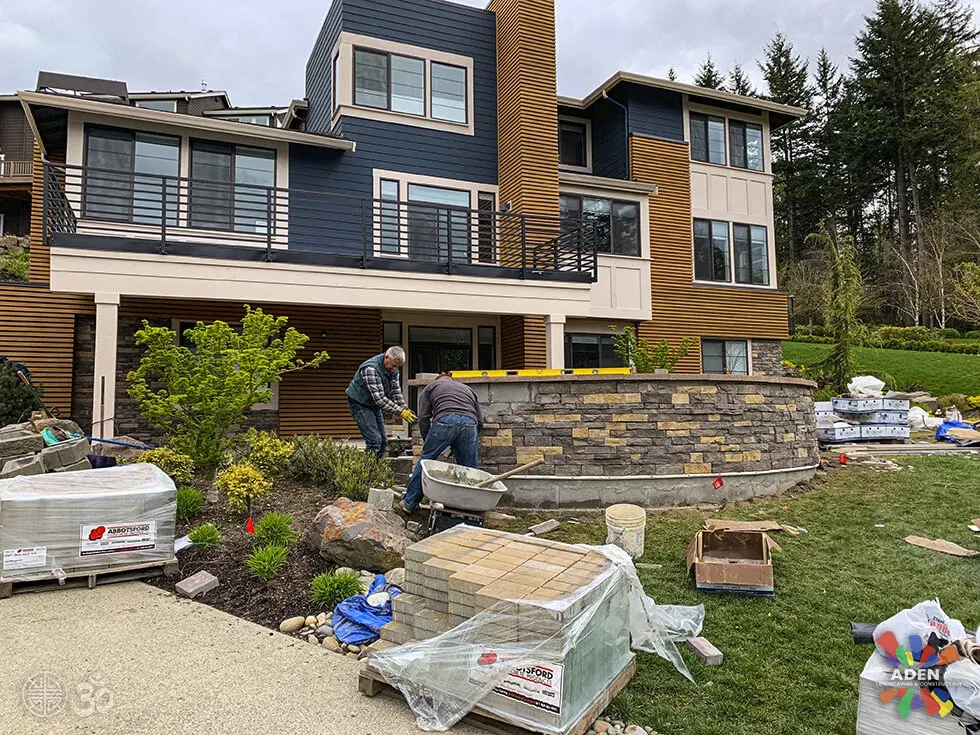
The crew setting veneer on the front terrace of a new build. The block core does the structural work and the stone is what you end up looking at — two different jobs, done in the right order.
 Paver PatioView full size
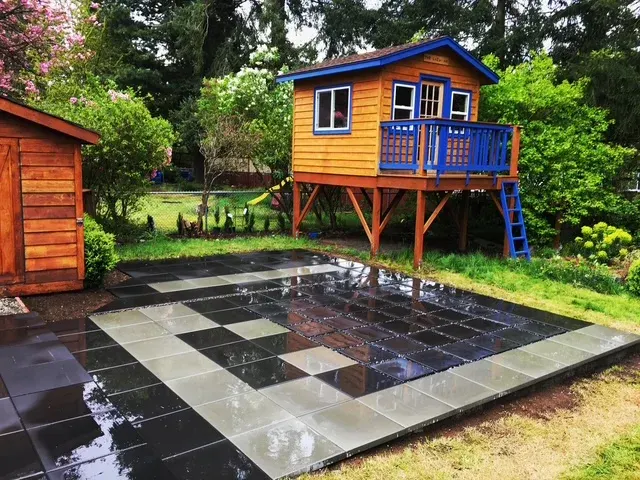
Large-format slabs laid as a chequerboard, squaring off the corner of the garden the playhouse stands in.
 WalkwaysView full size
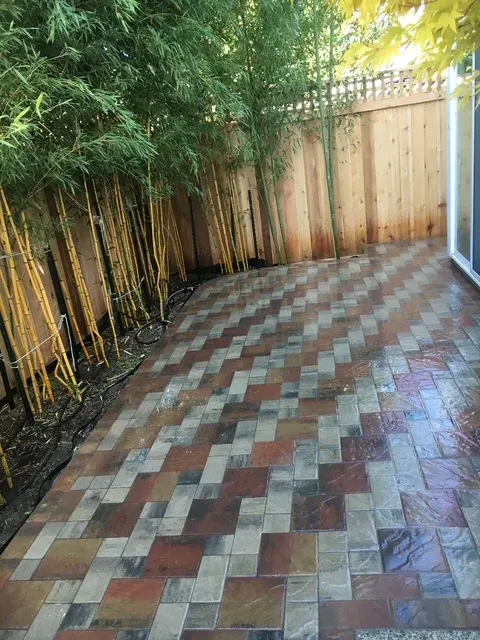
The strip down the side of the house nobody uses, turned into a proper route with a golden bamboo screen for privacy.
We come out, look at the ground, and put a fixed written price together. No deposit, and it does not change once agreed.
Free estimate
Three minutes on the form. We reply during office hours, Monday – Friday, 9:00 AM – 7:00 PM, and we come out and look at the site before quoting anything.
Or call (425) 533-9734
Thank you — we have your details. We reply during office hours, Monday – Friday, 9:00 AM – 7:00 PM. If it is urgent, call (425) 533-9734.