
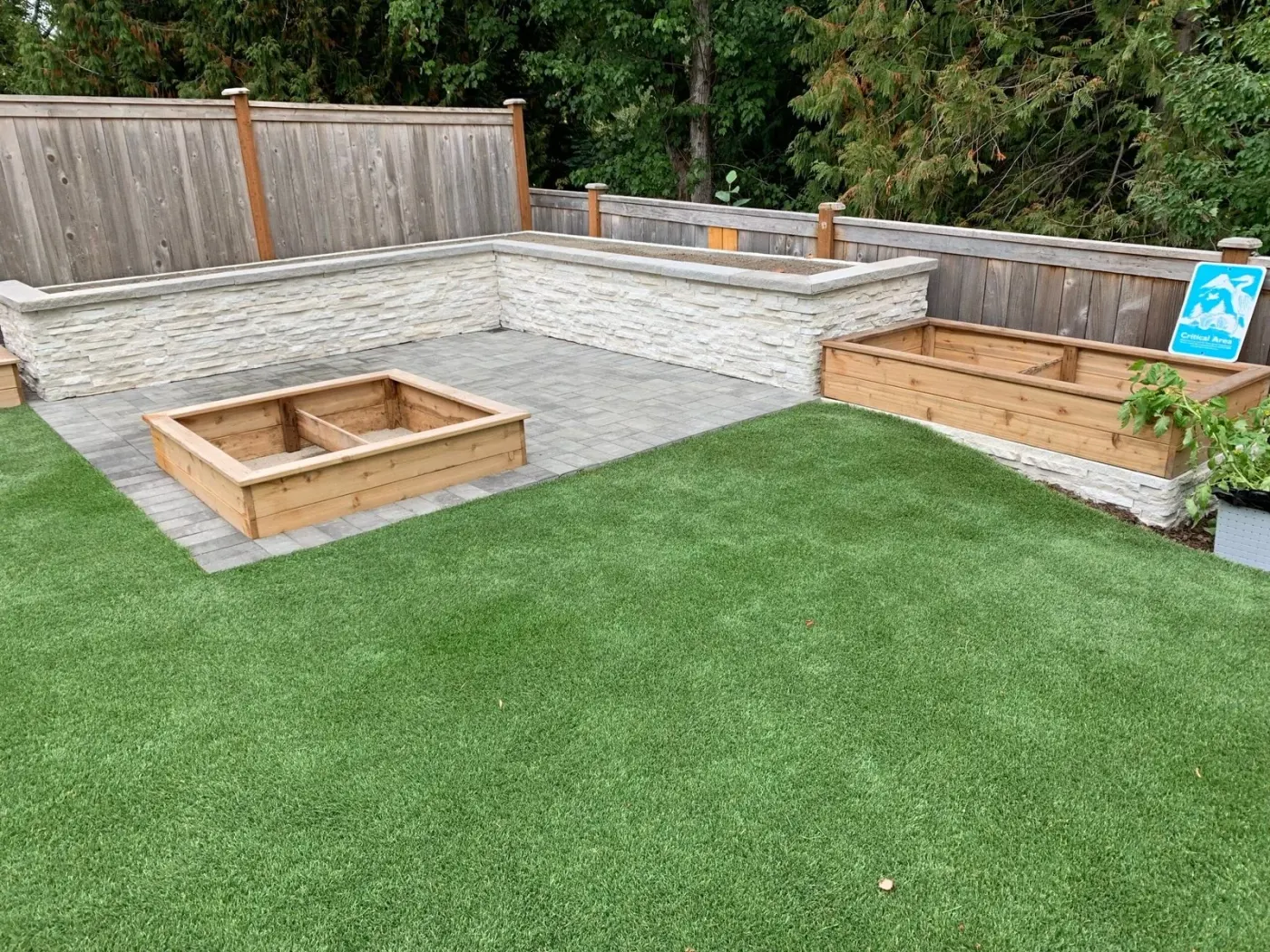
 Artificial TurfView full size
Turf lawn with cedar raised beds
A no-mow lawn for a small city yard, with cedar planters and a paved seating edge.
No down payment. You pay when the project is finished.
Monday – Friday, 9:00 AM – 7:00 PM · Capitol Hill, Seattle
Drainage · West Seattle
West Seattle is a plateau with steep edges, and drainage means something different on each. On the level ground through the Junction, Westwood and Arbor Heights it is ordinary till drainage: water perches on hardpan, saturates the topsoil and sits, and a properly cut and routed drain fixes it. On the bluff — along Alki, through Fauntleroy and down the Delridge side — water stops being a garden nuisance and becomes a stability factor. That ground has documented slide history, much of it carries steep slope or landslide-prone designations, and saturated soil is the mechanism by which a slope that has stood for decades starts to move. Where the water goes is the whole design there.
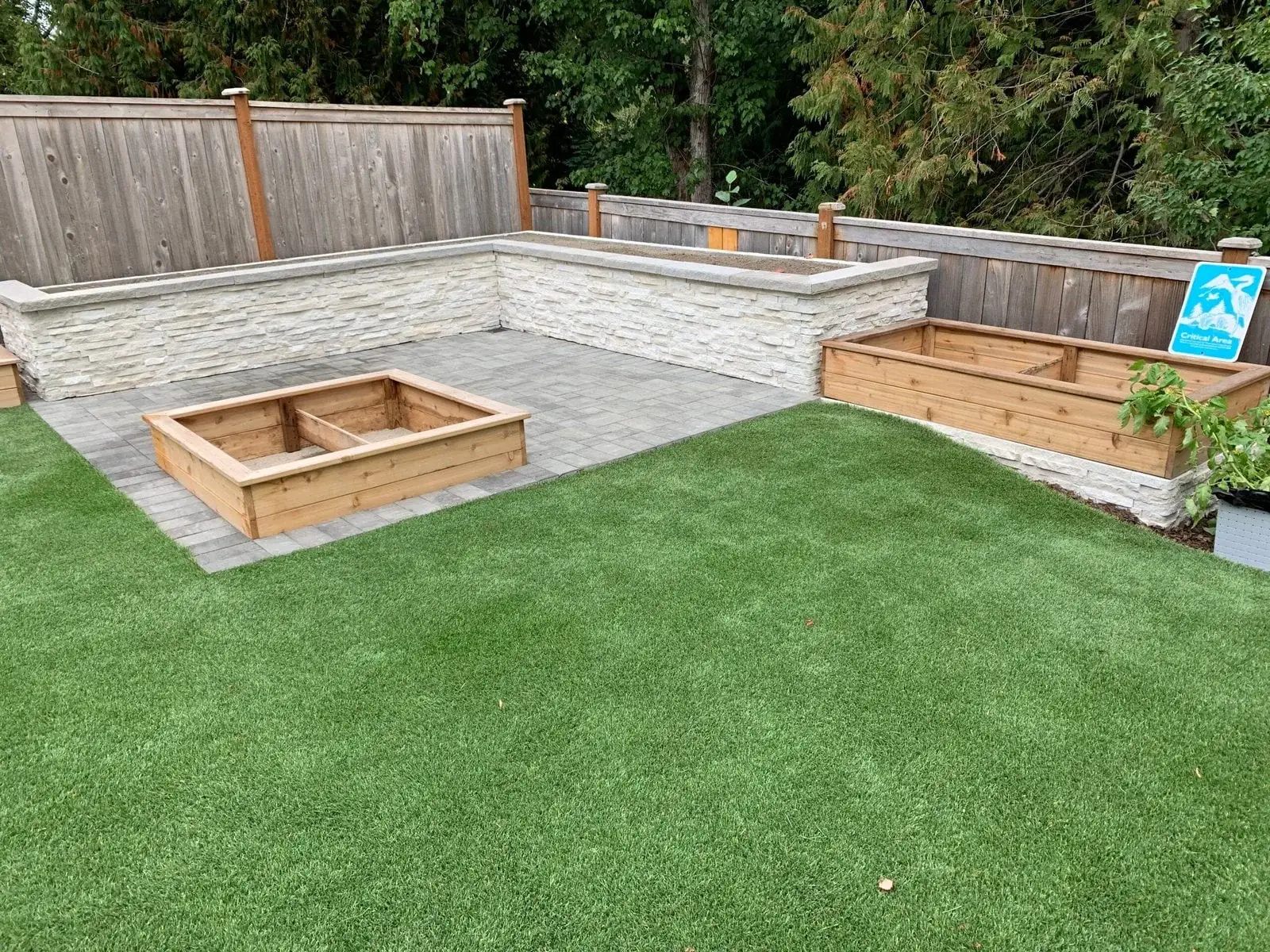
Artificial turf lawn framed by cedar raised planter beds and a paved seating area in West Seattle
What we get called about
West Seattle is a plateau with cliffs around it, and which of those two you are on decides the whole job. Plateau lots in the Junction and Westwood are straightforward, level and fast to build on. Bluff lots toward Alki, Fauntleroy and Delridge sit on ground with real landslide history, and a lot of them fall inside Environmentally Critical Area designations where the usual four-foot wall exemption does not apply. The view lots are the ones that need engineering, not just building.
Worth knowing in West Seattle
If your drain currently daylights over the bluff edge, that is worth addressing before your next project rather than after. A concentrated discharge onto slide-sensitive ground is the single most common way a well-intentioned drainage improvement becomes a slope problem.
The method
The sequence does not change between neighbourhoods — what changes is the ground it is applied to. Full detail on the drainage service page.
Roof, surface runoff, a neighbouring property's grade, or groundwater sitting on the till. These need different answers and guessing wastes the whole job.
A drain needs somewhere legal and physical to go — daylight at a lower point, or an approved connection. A drain that terminates in a hole is a soakaway on ground that does not soak.
Continuous fall along the whole run. A trench that dips holds water and silts up, which is the most common reason a retrofit drain stops working.
Perforated pipe bedded in clean washed rock, wrapped in geotextile so the surrounding soil cannot migrate in and clog the void.
Turf, planting or hard surface put back so the finished job does not read as a scar across the garden.
What it costs in West Seattle
Plateau drainage in West Seattle prices like ordinary Seattle work — $10 to $25 per linear foot, with most residential projects between $1,000 and $4,000. Bluff work is priced separately and honestly: parcels inside an Environmentally Critical Area carry a different process, the discharge design carries more consideration, and the programme is longer. A quote that treats a bluff lot as a plateau lot is a quote for a different job.
You pay after the project is fully completed.
The estimate you sign is the price you pay.
Spread the cost with no interest.
Covers hardscape work; vegetation excluded.
Local questions
General questions about this service are on the service page. These are the ones that only come up here.
Because on unstable ground water is not a nuisance, it is the mechanism. Saturated soil is considerably heavier than dry soil and has much less internal strength, and that combination is what turns a slope which has stood for decades into one that moves. On the bluff that makes uncontrolled surface water, a downspout discharging over the edge, or an old drain that has silted up into genuine risk factors rather than maintenance items. Any hardscape we build on that side of the peninsula is designed around where water leaves the property first, and on several bluff projects the drainage has been the entire job.
It depends on the parcel and on what is being built, and it is worth establishing early because the answer differs from the plateau. A large share of the West Seattle bluff carries steep slope or landslide-prone Environmentally Critical Area designations, and inside those, work that involves excavation, changes surface water routing or adds load is treated differently from the same work on level ground. We check the parcel against the city map before quoting so the process and the programme are known up front rather than discovered once a trench is open.
That is the design question, and there is usually an answer — it is just rarely the obvious one. Options include routing to an approved connection rather than to the slope, discharging at a controlled point away from the sensitive ground, or attenuating and dispersing flow rather than delivering it as a concentrated stream. Which of those applies depends on the parcel, the designation and what is physically available. What we will not do is take the cheap route of daylighting a system over the lip and leaving the consequence to arrive in a few winters.
Considerably. On the plateau through the Junction, Westwood and Arbor Heights you have ordinary Seattle conditions: glacial till, water perching on hardpan, a saturated topsoil layer that will not clear between October and March. That is a well-understood problem with a well-understood answer — a drain cut to consistent fall, clean rock, geotextile, and a real discharge point. Access on these lots is generally reasonable, so the work is straightforward and priced accordingly. It is genuinely a different project from a bluff lot half a mile away.
Serving West Seattle and surrounding neighbourhoods
Alki · Admiral District · The Junction · North Admiral · Fauntleroy · Gatewood · Morgan Junction · Delridge · Highland Park · Arbor Heights · Roxhill · Westwood
98106 · 98116 · 98126 · 98136 · 98146
Recent work
Artificial TurfView full sizeA no-mow lawn for a small city yard, with cedar planters and a paved seating edge.
 HardscapingView full size
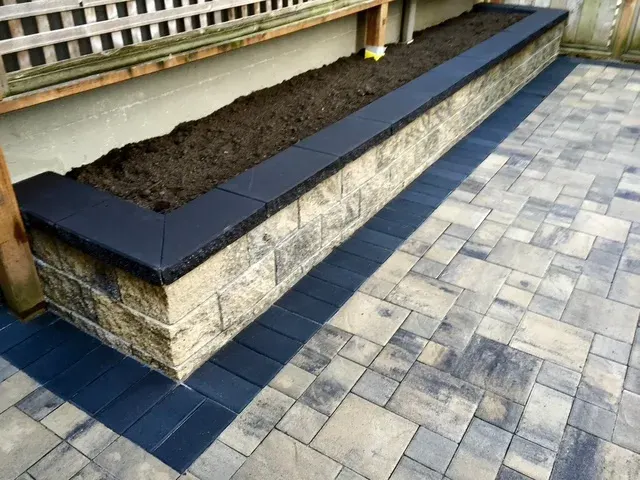
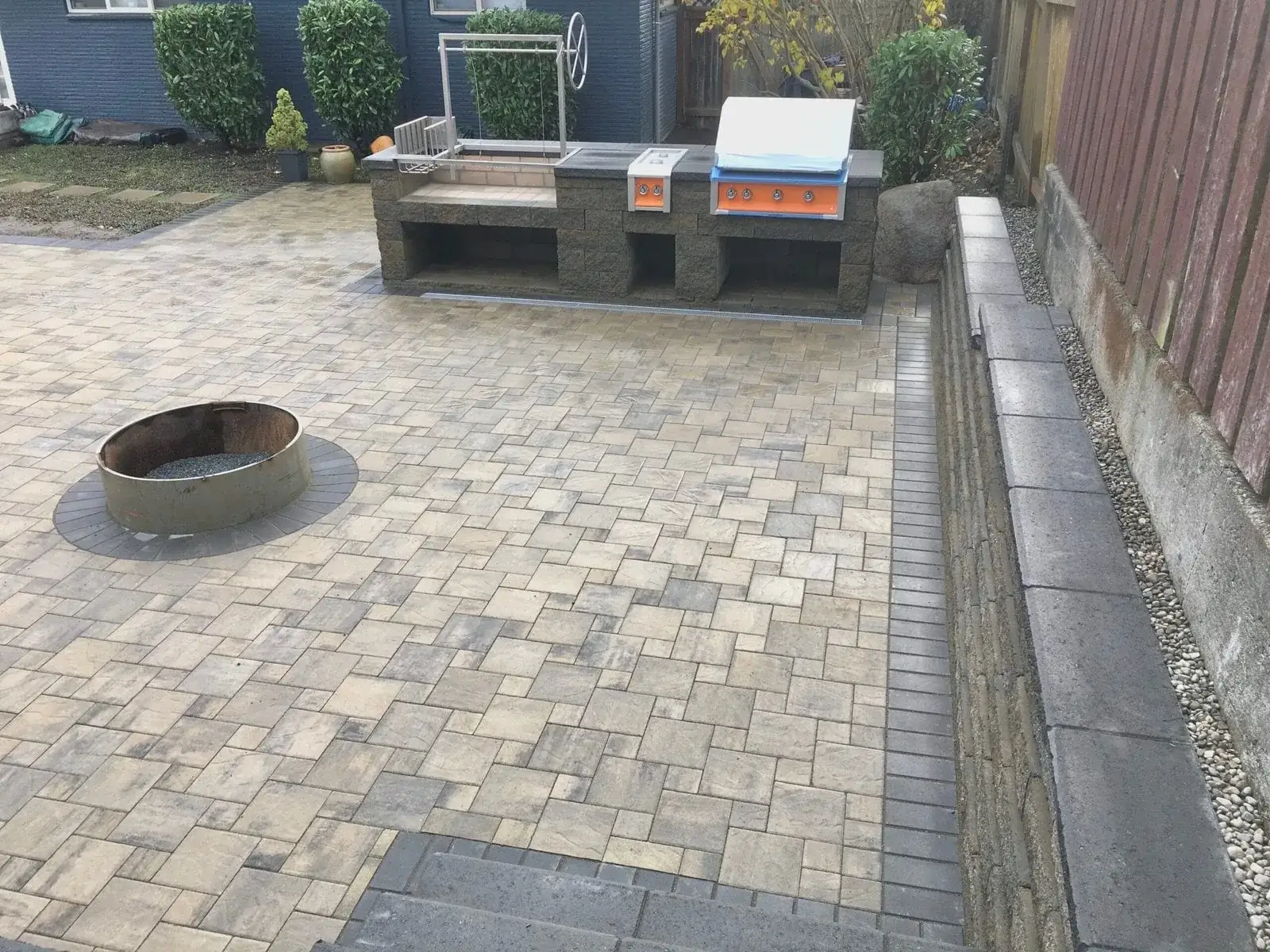
A raised planter running the length of the terrace, capped in charcoal to pick up the darker banding in the paving.
 DeckingView full size
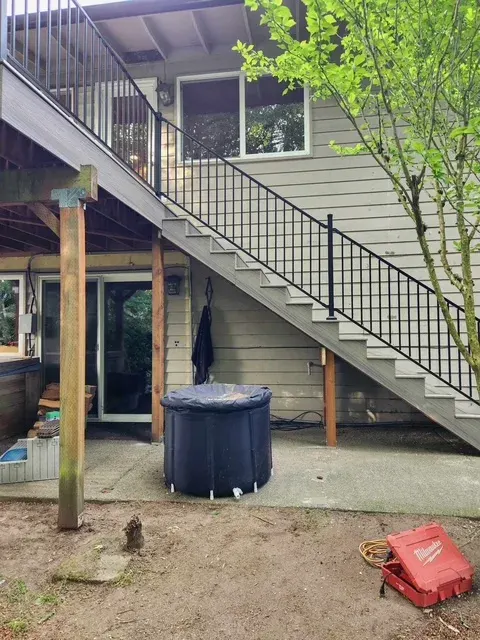
A West Seattle split-level where the only way to the bottom of the garden was through the house. A full-height run of stairs off the deck fixed that.
 Retaining WallsView full size
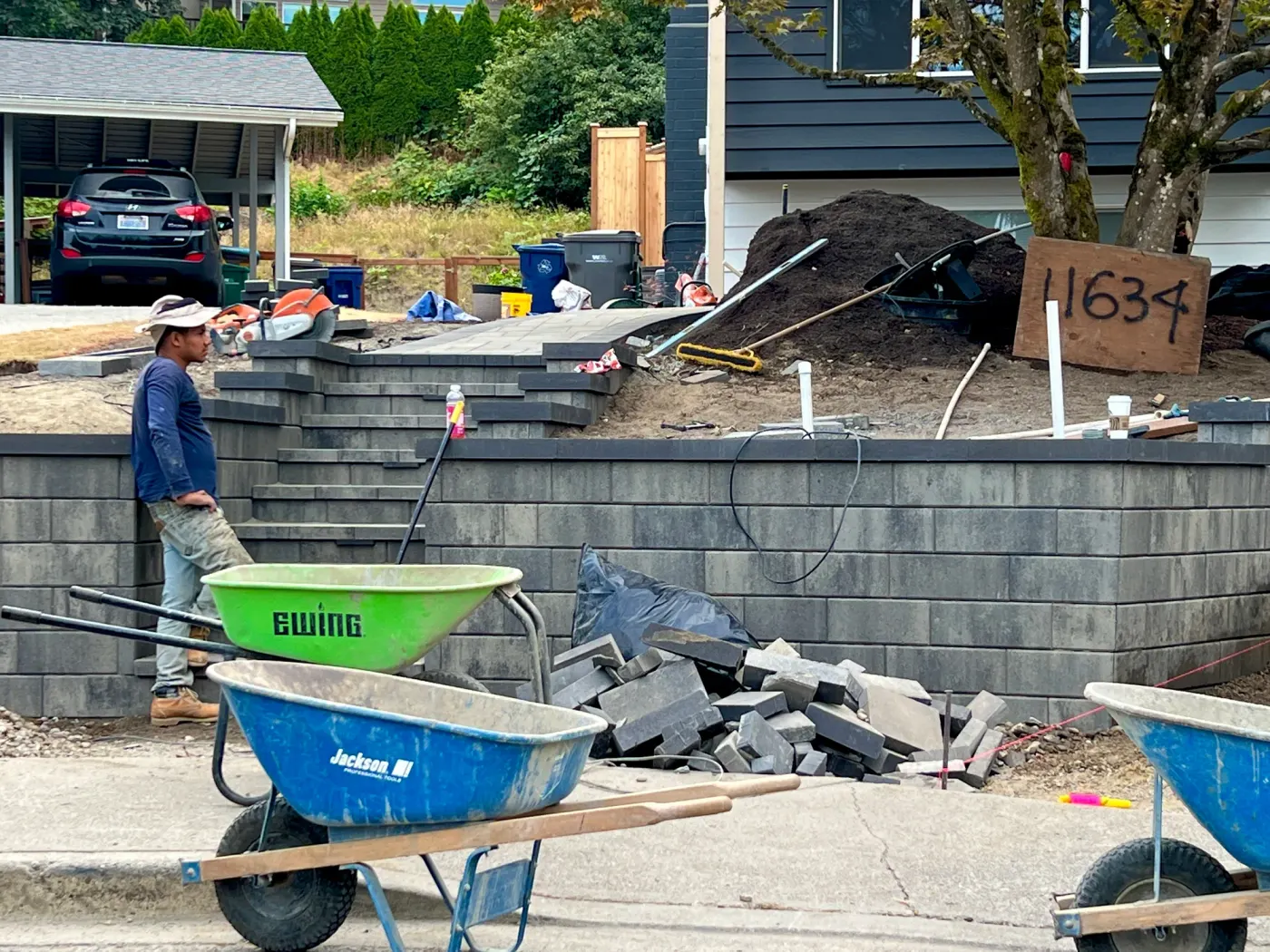
Mid-build on a West Seattle slope: block stacked, barrows running, the old surface still down. One crew on one site until it is finished, which is the only way the levels stay honest.
We come out, look at the ground, and put a fixed written price together. No deposit, and it does not change once agreed.
Free estimate
Three minutes on the form. We reply during office hours, Monday – Friday, 9:00 AM – 7:00 PM, and we come out and look at the site before quoting anything.
Or call (425) 533-9734
Thank you — we have your details. We reply during office hours, Monday – Friday, 9:00 AM – 7:00 PM. If it is urgent, call (425) 533-9734.