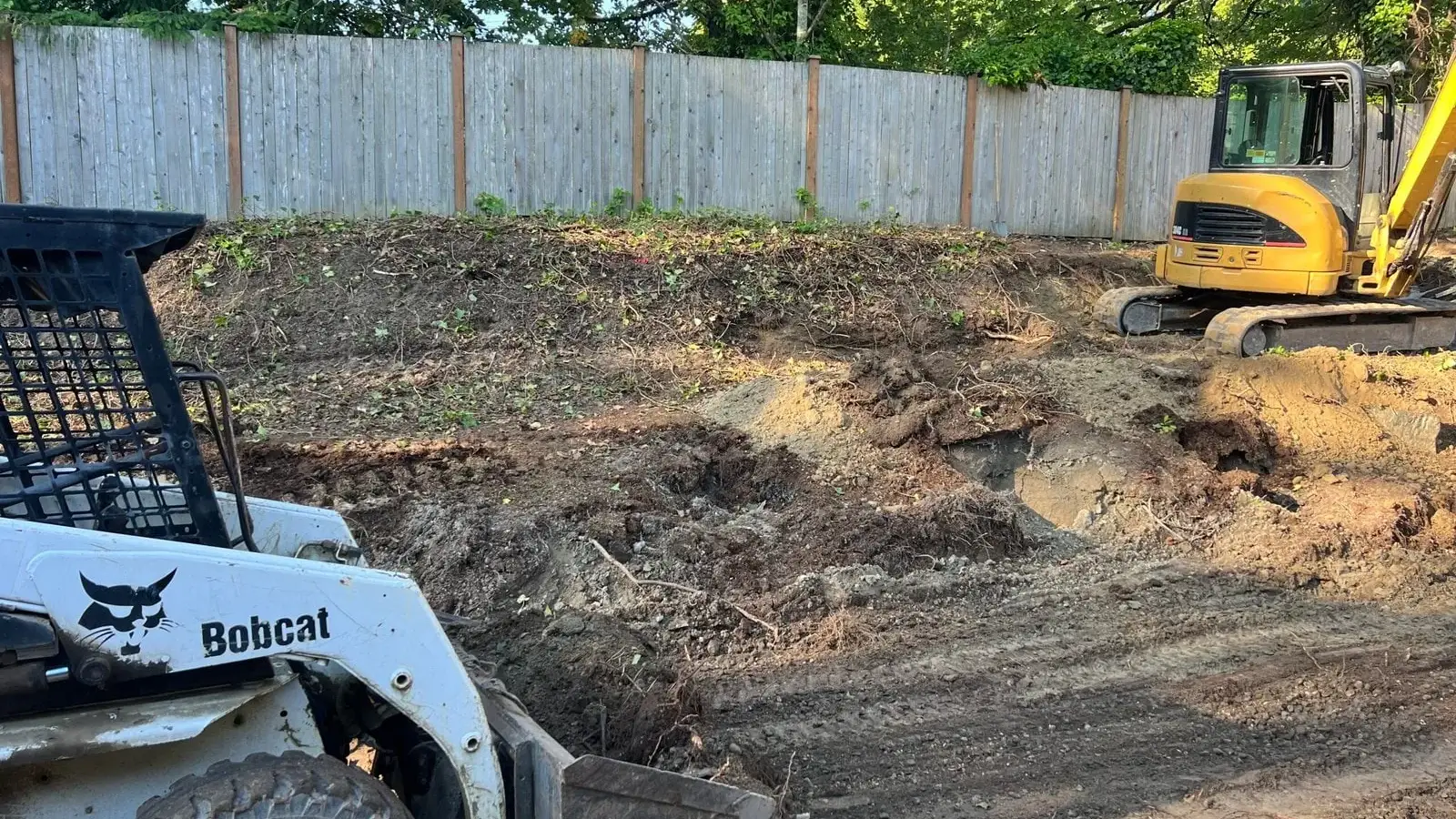
Every October we start getting the same call. The lawn was fine in August. Now it is spongy underfoot, there is standing water in the low corner three days after the rain stopped, and by February half of it will be moss.
The homeowner has usually already tried the obvious things — aerating, reseeding, spreading topsoil — and is calling because none of them worked. They did not work because none of them addresses what is actually happening.
The ground under Seattle does not drain
Most of this city sits on glacial till, sometimes called hardpan. It is the compacted layer left behind when the ice sheet that carved Puget Sound retreated, and it is dense enough that water moves through it extremely slowly. Above it there is typically twelve to twenty-four inches of topsoil — the part your lawn is actually growing in.
Through the dry months this arrangement is invisible. Rain falls, the topsoil absorbs it, and what is not used evaporates or is taken up by plants.
From October it stops working. Seattle takes more than 38 inches of rain a year and almost all of it arrives between October and March. Water soaks down through the topsoil, reaches the till, and stops. Once that upper layer is saturated there is nowhere for the next inch of rain to go, so it sits on the surface.
That is the whole mechanism. It is not a lawn problem, it is a plumbing problem.
Why the usual fixes do not work
Aerating relieves compaction in the top few inches of soil. If your problem is a heavily used lawn on ground that otherwise drains, it genuinely helps. If your problem is a saturated layer sitting on hardpan, you have made a few thousand small holes into an already-full sponge.
Adding topsoil raises the level of the low spot, which moves the puddle rather than removing it. On a flat lot it frequently creates a new low spot somewhere else.
Reseeding puts new grass into ground that killed the last lot. Grass roots need oxygen, and permanently saturated soil has none. This is also why moss wins: moss is perfectly happy in conditions that grass cannot tolerate, so it is not really an invader, it is a symptom.
Flat lots are worse than sloped ones
This surprises people. On a sloped lot in Queen Anne or Mount Baker, surface water at least runs across the ground and away — the slope is doing something for you. On a flat lot in Wedgwood, Maple Leaf or Green Lake, water that reaches the surface has nowhere to run at all.
That is why the flattest neighbourhoods in Seattle have the worst-draining gardens, which is the opposite of most people’s intuition.
What actually fixes it
The water needs a route out of the property. There are three ways to give it one, and the right answer depends on where the water is coming from.
Find out where it comes from first. Roof water, surface runoff from your own ground, runoff from a neighbouring property higher up, or groundwater sitting on the till. These need different answers, and guessing wastes the entire job. A downspout discharging into a border is a huge volume arriving in one spot, and tying it into a proper run can solve a problem that looked like it needed a whole drainage system.
Regrading reshapes the ground so it falls away from the house and toward somewhere water can go. Where the problem is a single low area or water pooling against the building, this is often cheaper and less disruptive than a drain, and we will say so.
A French drain is a trench cut to a consistent fall, containing perforated pipe surrounded by clean free-draining rock and wrapped in geotextile. It collects water from the surrounding soil and carries it somewhere else. Three details decide whether it lasts:
- A consistent fall along the whole run. A trench that dips holds water and silts up, which is the most common reason a retrofit drain stops working after two years.
- Clean washed rock, not fines. The void between the stones is what carries the water. Fill it with sandy material and there is no void.
- Geotextile wrap. Without it, soil migrates into the rock over a few seasons and the drain silts up from the outside in.
The question that separates a working drain from a wasted one
Where does the water go at the end?
This is the first thing we establish and the thing most often skipped. A drain needs somewhere legal and physical to discharge to — daylight at a lower point on the lot, or an approved connection. On a sloped Seattle property daylight is frequently achievable.
What does not work here is a soakaway pit. The entire reason your garden floods is that the ground will not absorb water; digging a hole, filling it with rock and running the drain into it just relocates the puddle underground. Anyone proposing one on till has not thought it through.
When to look at it
Counter-intuitively, the wet months are the best time to assess drainage. Between October and March we can see exactly where water collects, which way it runs and how long it takes to clear — information that a dry August site visit simply cannot give you. If your yard is under water right now, that is the moment to have someone look at it, not next spring when the evidence has gone.