Most landscaping companies in this market will not publish a number. We think that is a mistake — you cannot evaluate a quote without a sense of what the work should cost, and a homeowner who has no reference point ends up choosing on price alone.
So: $20 to $50 per square foot installed, including excavation, base preparation, edge restraint and drainage falls. A typical Seattle residential patio lands between roughly $2,500 and $7,200.
That is a market range rather than our price list. What follows is why the range is that wide.
Most of the money is under the surface
The pavers are the cheapest part of a paver patio. What you are actually buying is the build-up beneath them, and on Seattle’s ground that build-up is doing two jobs at once.
Elsewhere in the country, a modest base works partly because water passing through the surface keeps going down and away. Here it does not. Our glacial till is dense enough that water reaches it and stops, then moves sideways through whatever base was laid. So the base has to spread the load and provide the drainage path the subgrade cannot.
For a pedestrian patio that typically means six to eight inches of compacted crushed rock below the finished surface, plus the bedding layer and the paver itself. Deeper where the ground is soft, where a vehicle will cross it, or where the lot sits at the bottom of a slope taking water from uphill.
Anyone quoting a fixed depth without looking at your ground is guessing.
Compaction in lifts is the invisible line item
Base material has to be placed in shallow layers and compacted layer by layer. This matters because a compactor only transmits meaningful force a limited distance into loose material — run one over twelve inches of freshly tipped rock and you get a firm crust with uncompacted material underneath it.
That looks identical on the day the job finishes. It settles over the following two years.
Lifts take more machine time and more crew hours, and they are a substantial part of why two quotes for the same finished surface can differ by thousands while describing the same thing.
Access is the other big variable
A patio that takes two days on a Bellevue lot with a driveway can take four on a Capitol Hill lot where every barrow of base material goes through a three-foot gate.
That is not a small adjustment. On tight city lots the labour of moving material can exceed the cost of the material itself, and it is the single most common thing missing from a quote that looks cheap on first reading. We walk the access route before quoting and price it as its own line.
What pushes a project toward the top of the range
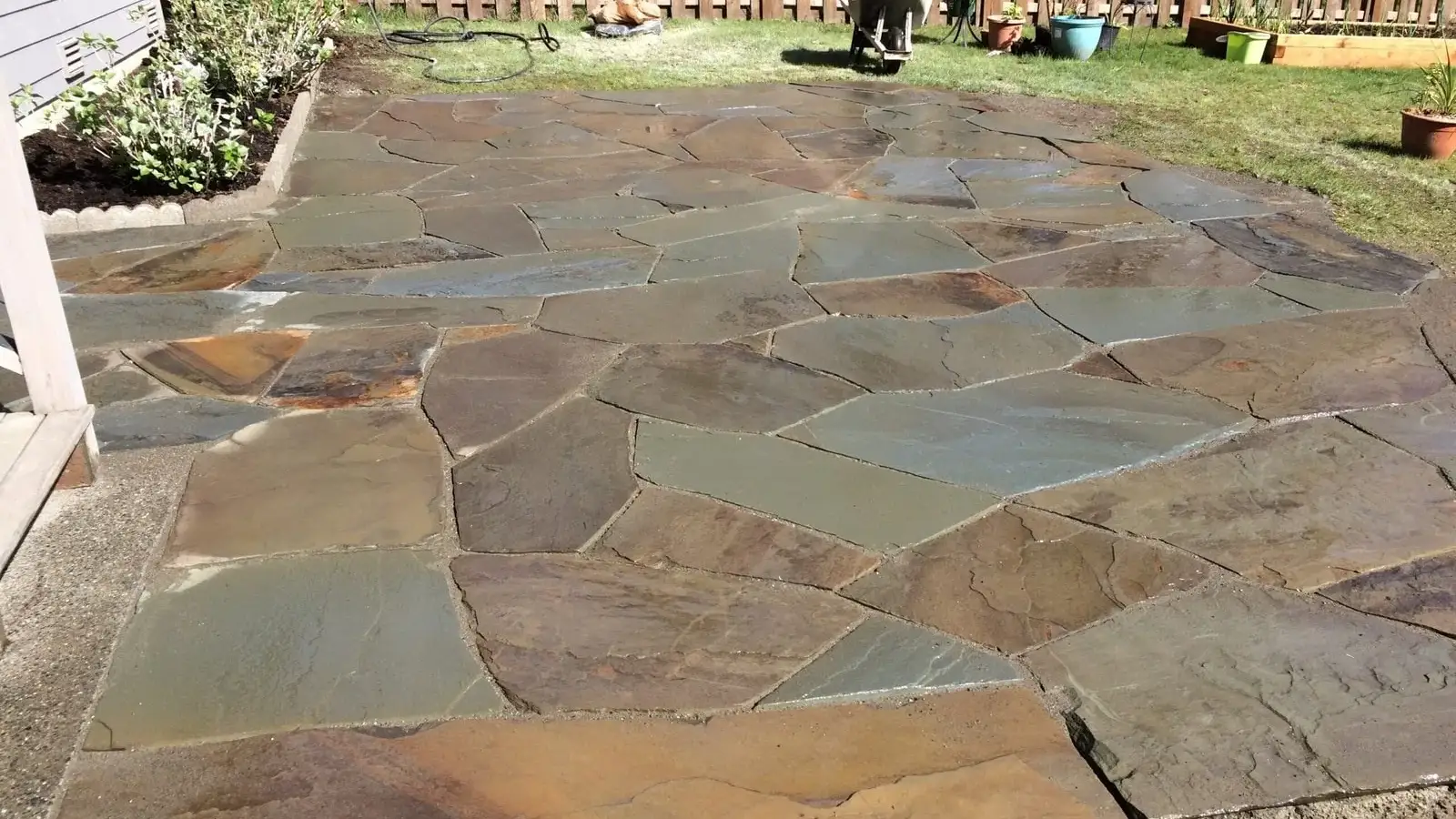
- Natural flagstone rather than concrete pavers. Every stone is cut and fitted by hand, and it is the most labour-intensive surface we lay.
- Complex shapes. Curves and angles mean cutting, and cutting is time.
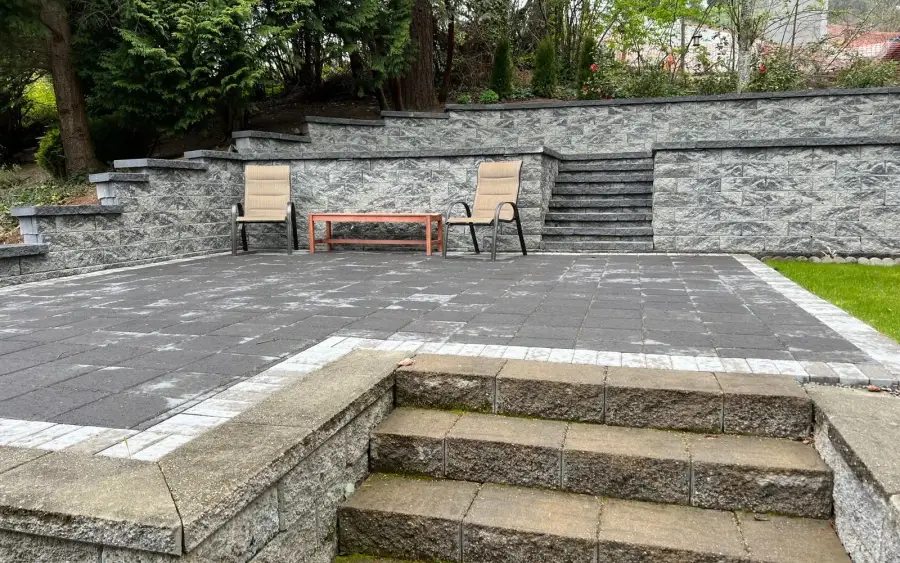
- Steps and level changes, which are priced separately and are the most labour-intensive part of any patio that is not on one plane.
- A drainage problem that has to be solved before the patio can be built.
- Poor access, as above.
What brings it down
- A simple rectangle in a standard paver format, laid in a running bond.
- Good access — a driveway, or a side return a machine can pass through.
- Ground that already drains, which in parts of Ballard and Crown Hill genuinely happens.
- Doing it alongside other work. If a machine is already on site and the ground is already open, the marginal cost of a patio is meaningfully lower than as a standalone job.
How to compare two quotes properly
Ask both contractors three questions:
- How deep are you excavating, and how many lifts is the base going in? If one answer is “four inches” and the other is “six to eight, compacted in three lifts”, you are not comparing the same product.
- What is the edge restraint? Without it the field creeps outward over time and the joints open. It is cheap and it is often omitted.
- Where does water go? A patio should shed water away from the house at a fall you cannot feel underfoot but the rain can find. If nobody has mentioned falls, nobody has thought about it.
The cheapest quote is frequently the one that answered none of those questions, and the difference shows up in year three rather than year one.