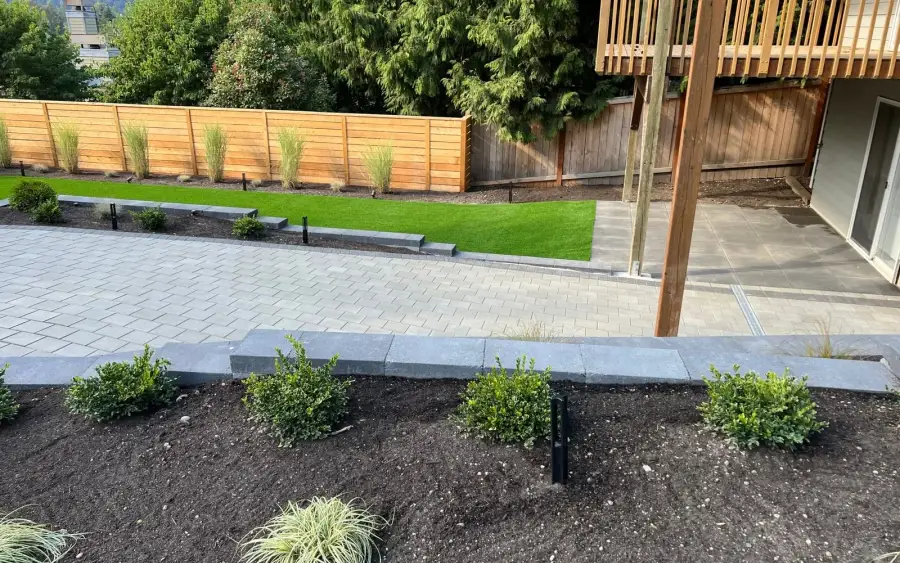
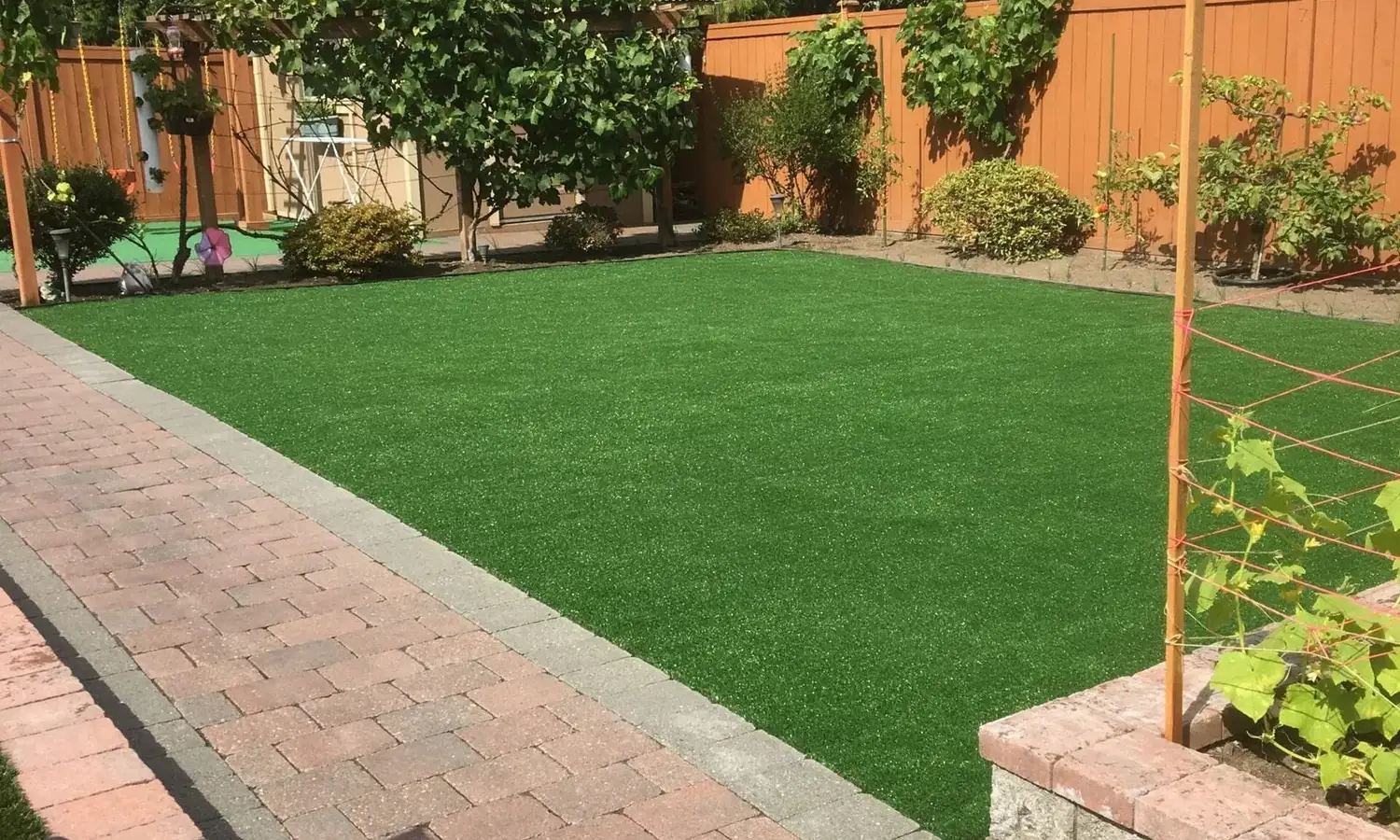
We install a lot of artificial turf and we talk a reasonable number of people out of it. Both are the same conversation, which is about whether real grass was ever going to work in the specific spot you are standing in.
When turf is genuinely the right answer
A shaded north-facing garden. This is the classic Seattle case. The lawn is shaded by the house on one side and a neighbour’s cedars on the other, gets perhaps two hours of direct light in midsummer and none in December, and has already been reseeded two or three times. No amount of seed changes the light.
A dog that uses the same patch every day. Real grass does not survive concentrated use plus concentrated nitrogen, and the mud that replaces it comes into the house from November to April.
A play area used year-round. From November, a natural lawn on undrained till is saturated. It compacts under use, the grass thins, and by February the play area is bare soil.
A lawn under about 400 square feet. At that size the maintenance per square foot is high, the shade from surrounding buildings is proportionally worse, and wear concentrates on the few square feet people actually walk across.
When fixing the lawn is the better buy
If your garden gets four or more hours of direct sun, drains reasonably, and the problem is that the lawn has been neglected rather than that it is in the wrong place, then aeration, top-dressing, overseeding and a proper feeding regime will get you a good lawn for a fraction of the cost of turf.
We say this fairly often and we mean it. The tell is usually history: a lawn that has failed repeatedly despite reasonable care is telling you something about the site, whereas a lawn that has simply been ignored for five years is telling you something about the last five years.
The base decides everything
This is the part that gets skipped, and it is the reason for most of the disappointed turf owners we meet.
Modern turf backing is perforated and passes water at a rate far above anything Seattle rainfall produces. The turf is not the bottleneck. The problem is what happens next: if the turf is laid over unimproved glacial till, water passes straight through the backing and then stops dead on the hardpan. You now have a shallow reservoir underneath your lawn.
That is what causes the soggy feel underfoot, the smell in pet installs, and the slow uneven settlement. It is not a product failure, it is an installation failure.
A proper install excavates and builds up in compacted free-draining crushed rock, graded to a fall — a drainage base, not merely a levelling base. On a lot that also takes runoff from uphill, that means solving the drainage before any turf goes down.
Pets, honestly
Turf is safe for dogs, and whether it smells is entirely down to the install rather than the product.
Urine passes through a permeable backing into the base. If that base drains and gets rinsed periodically, there is nothing to hold odour. If it sits on compacted soil, the liquid has nowhere to go and the smell is inevitable.
For dog owners we specify a permeable backing, an infill that does not retain ammonia the way older sand-only fills did, and enough drainage depth for an animal that uses the same corner every day. A hose-down every few weeks in summer is the only maintenance.
What it costs, and why it varies by neighbourhood
$13 to $24 per square foot installed. The variation by neighbourhood surprises people: Laurelhurst, Madison Park and Magnolia installs typically run $17–24, while South Seattle sits closer to $13–16.
The driver is not the postcode itself. It is what those lots need — access, excavation depth, drainage and turf specification — and how much base has to be imported before anything green goes down.
Lifespan, fading and heat
A well-installed turf on a proper base is generally good for fifteen to twenty years of domestic use, and Seattle is unusually kind to it: the thing that ages turf fastest is intense UV, and we get less of it than almost anywhere in the country.
The two things that shorten its life are both install faults — an inadequate base that lets the surface go uneven, and skipping the infill so the pile flattens permanently.
On heat: turf does get warmer than grass in direct sun, and this is one area where Seattle simply has less of a problem than a hotter market. On our handful of genuinely hot days a turf lawn in full sun is noticeably warm underfoot in the early afternoon and comfortable again by evening. A hose-down drops the temperature within a minute.
The honest summary
Turf solves a specific set of problems extremely well and is a waste of money on a site where grass would have thrived. The question is never “turf or lawn” in the abstract — it is what your particular garden gets in light, drainage and use, which is why we would rather look at it than answer over the phone.